
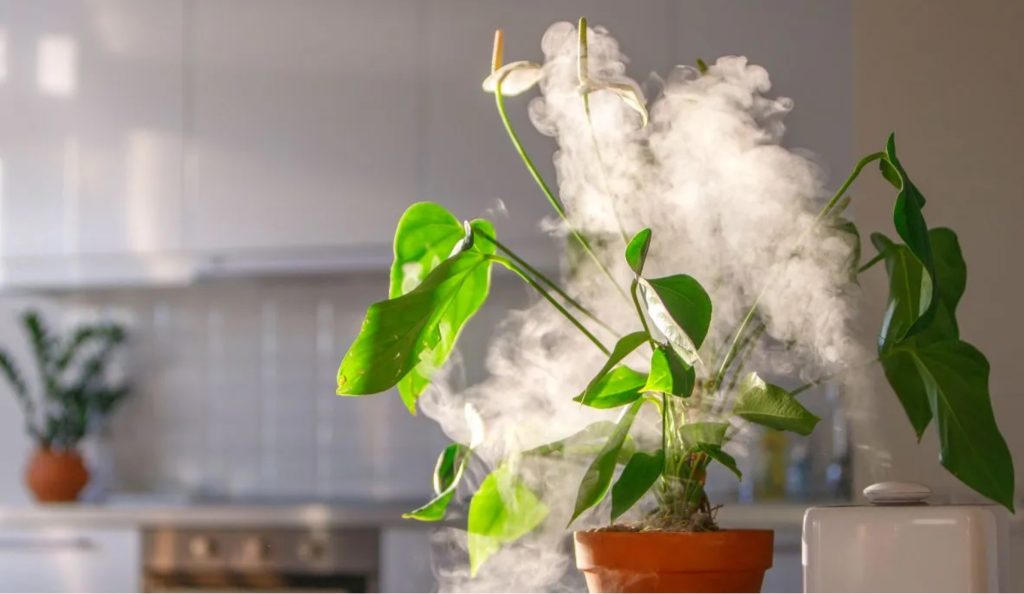
Steamy Secrets to Thriving Houseplants
Plants have evolved to grow outdoors in the natural world. However, humans seem to have a need to connect with nature, and we want to bring it indoors. This is understandable if you are in an urban area living in an apartment, but being humans, even if we have a home with a lush garden, we still want to have plants in our homes for our personal enjoyment. Unfortunately, our homes are not a welcoming environment for plants, primarily due to low light and low humidity. We call them house plants because they will survive inside our homes, but no plant would ever choose to grow indoors.
 My wife and I moved to Memphis from Ohio in August of 1981. Every time we stopped for a break it was about 20 degrees hotter outdoors than the last stop and 10 percentage points more humid. My wife and I had lived our entire lives until that point in Ohio, and I can tell you it was a stressful transition. The looks I received from my wife each time we got out of the car added to the stress of the move as her eyes questioned the decision we had made. Apparently, she is more like the delicate flower that prefers the environment of a mountain meadow and wilts in our less than temperate summers.
 Commercial growers know how difficult growing indoors can be, so most of the houseplants available to us have been selected for their ability to deal with low light conditions. These plants often grow in the understory of tropical forests where humidity is high. In summer, we have plenty of light and humidity here in the Mid-South, so we typically treat our indoor plants to extended summer vacations outdoors. Recalling the looks my wife gave me during our move to Memphis, I can imagine the stress our plants feel as they are moved between light-filled humidity and our dark, dry homes, and back again each year. They often respond by dropping leaves that they had adapted to one set of conditions so that they can put out new leaves for their new conditions.
 Rather than stressing your plants and yourself by moving your plants in and out, you may want to consider leaving your houseplants indoors year-round so that they are not so stressed. Focus on providing the best conditions you can for them. After all, if you enjoy having indoor plants, why deprive yourself of the pleasure for half of the year?
Try not to kill your houseplants with kindness. More houseplants die from overwatering and/or poor drainage than anything else. My success rate with indoor plants has increased dramatically since I got a water meter. Available at your local garden center and most hardware stores is a simple tool. Just stick the probe a few inches into your soil, and the meter will tell you if it is wet or dry. Most houseplants want to be on the dry scale before they are watered. You can also use your finger; it works just as well, but many ruin your manicure.
Over fertilization can also cause problems. I like to use an encapsulated time release fertilizer at about half of the recommended rate. One common brand name is Osmocote. It gently feeds low doses of fertilizer to the plant each time it is watered. Be sure to mark your calendar with a reminder to reapply based on the package directions because the little beads that hold the fertilizer do not look any differentonce the fertilizer is gone.
While houseplants offered for sale have been selected for low light conditions, they will benefit from as much light as we can provide indoors. Placement near windows helps. South-facing windows are the brightest, followed by west, east, and north-facing windows. Do not allow your plants to touch the windows, as summer heat and winter cold can damage leaves in contact with the glass.
We can remedy some of the light issues by providing supplemental artificial light. We are fortunate to be living in the age of LED lighting, as these lights are bright and do not generate a lot of heat like the old incandescent bulbs. You do not need to purchase special grow lights to benefit from supplemental lighting. Full-spectrum bright white, cool white, or daylight LED will do just fine. The soft white will help, but will not be quite as effective.
An often overlooked issue is home humidity. By choosing plants that naturally live in dry conditions, like cactus, succulents, or anything with a thick, waxy leaf, you will significantly improve your success with houseplants as long as you don’t overwater. Humans and many houseplants like humidity levels of 40-60%. Cacti and succulents are happy with 30-40% humidity, while tropical plants like ferns and orchids prefer 60-80% humidity. Our homes are seldom at this level in winter, when we run our heating units, humidity levels of 20-30% are typical. In summer, standard air conditioning leaves our humidity at comfortable levels, but the lower you adjust your temperature, the lower the humidity will be in the home.
To raise the humidity for our plants, there are two often recommended methods that make logical sense but don’t really work. The first myth is to mist the leaves of your houseplants. Yes, it is true that misting does raise the humidity for the plant, but it is effective only as long as the moisture remains on the leaf. This gives the plant about 5 minutes before the mist has evaporated. It does no harm to the plant, and as you go through the routine, you will be inspecting the plant and can spot any issues, such as a bug infestation, in the early stages when it is easy to fix, so there are side benefits to misting. If you enjoy the activity, keep it up, but know that you are not having any significant impact on the humidity.
The other myth is to put your plants on a tray of pebbles, then add water to the pebble tray. As the water evaporates, it creates a zone of higher humidity around the plant. Yes, this is true, but the zone of higher humidity is only about one inch above the lip of the pebble tray, and your plant is sitting well above this. I have a brother-in-law who wears cheap cologne. When he comes to visit, I can smell him well before I can see him as his cologne permeates the air. The same thing happens with water vapor. It is highest at its source but rapidly moves from areas of high concentration into areas of lower concentration in an attempt to equilibrate within the space. So you help a bit by putting more available moisture into your house, but the impact of that will not impact your plants.
So, how do you raise the humidity levels for your plant? If you are like me, the only measure of humidity levels in the home is the amount of static electricity there is and how dry my skin feels. It would be helpful to begin by measuring the actual level of humidity in your home. You can purchase a hygrometer that will measure your home’s humidity. Now that you can measure it, you can begin to control your humidity. Check the levels in several rooms. Normally, bathrooms and kitchens have slightly higher humidity levels as they are sources of water. If you have the right light and plant for those rooms, it will help a bit.
 The most effective method, however, is to work to raise the humidity level within your entire home. Both you and your plants will feel better. You can use a whole house humidifier if you have a forced air heating system. They are fully automated and only need routine maintenance. A step down from that would be a room humidifier. There are two types of room humidifiers, both of which rely on a water reservoir that must be manually refilled. Evaporative humidifiers use a wick filter and a fan to evaporate water into the air. An ultrasonic humidifiers create a fine mist using vibrations (no heating). You can also get small ultrasonic humidifiers to place near your plants, but be sure there is enough room above them with adequate air circulation so that the mist can fully evaporate and disperse. The room humidifier will raise the humidity level in that room, and as that air is circulated through the rest of the house, there will be a less pronounced effect in those rooms.
December Garden Activities
Plant: Trees, woody ornamentals, tulips, and other spring-flowering bulbs.
Lawn Care: Apply lime if indicated by soil test.
Prune: Collect garden greenery for holiday decorating. When pruning, cut back to a branch so as not to leave a stub. When cutting conifers, don’t go beyond the innermost needles. If you do, it may not regenerate from that point again. To extend the life of fresh-cut greenery, soak it in a bucket of water overnight to hydrate the leaves and stems before using.
Other: Look at the garden’s successes and failures and plan for next year. If no rain, water plants prior to a freeze. Protect tender plants by placing mulch or pine straw to a depth of 6-8 inches (remove in spring). Consider recycling old Christmas trees or simply place them in the back of the garden for wildlife habitat. While it may seem early, December can be a great time to order seeds for your 2026garden, especially those you plan to grow as transplants. Clean, repair (if needed), and store your garden tools for next year.
Learn: Attend Bartlett Gardening University Saturdays at 2:30 PM, Bartlett Library, 5884 Stage Road. Six sessions January 17, 24, 31, and February 7, 14, 28, 2026
