
During infant baptisms at my church, the priest takes the child from the parents and says, “Name this child,” just before the actual baptism. Names are important to us; when we know a person well, their name carries with it our entire relationship history when it is spoken. Names of plants are also important. Common names can be confusing, as the same common name can often refer to several very different plants. Knowing and using a plant’s botanical names removes any confusion. With people, a name like Bob can bring to mind several folks that I know who are very different from each other. One Bob from my childhood will forever be on my “not a friend” list. To remove confusion as to which Bob I am referring to, the surname must be used.
I also have a list of plants that are on my “not a friend” list. They may be garden thugs that are difficult to control with a tendency to take over too much of my garden bed real estate. Others are uninvited plants invading my garden beds. I know them well and remove them on sight. There are other plants, however, that appear in my beds that I don’t always recognize, especially in spring. I have, in the past, inadvertently pulled up young poppies that simply looked like they could be weeds. I did not know it well enough to recognize them in their juvenile stage for what they were. I felt terrible when I later remembered that I had strewn poppy seeds in that area the previous fall. So now the rule in my garden is: Don’t pull it up unless you can name it. Right now, I am waiting to see if one particular unfamiliar plant is something I planted and forgot about or a weed. While it frustrates me that I can’t recall what may have grown there last season, it is also kind of exciting. Like waiting to see what is inside the box from Amazon you just received, when you can’t remember having ordered anything.
By using the term weed I am assuming these are the plants you do not want in your landscape. Many “weeds” in fact are quite beautiful, and you might have considered growing them if they required more effort instead of simply showing up in your garden or lawn on their own. After all, why do we regard a dandelion so differently from a daffodil? They both produce cheery yellow blooms in early spring, and after flowering, the dandelion blends in with its surroundings, while the daffodil has that annoying, tall, floppy leaf that must remain for months if you want to have flowers the next year.
When it comes to weeds, you also need to know a little about them if you hope to control them. This starts by being able to name them. Use a plant identification app, send a picture to your local extension agent, or bring a sample to a local independent garden center for help. Many of our weeds are annual plants that grow, bloom, set seed, and die all in one season. The first line of defense in controlling them is to prevent them from setting seed, thereby reducing the number of seeds available for next year. Do this by mowing or otherwise removing the bloom before it can make new seed. In garden beds, a layer of mulch will help to keep seeds in the soil from germinating by cutting off their exposure to light. Mowing the lawn high will help to shade out weeds and allow your lawn grass to gather more sunlight, making for a healthier turf.
I found the use of a preemergent to be valuable in controlling weeds. It puts down a barrier to keep seeds from germinating that lasts for several months. Repeat applications at the appropriate intervals to control weeds throughout the year. However, be aware that if you want flowers to reseed in your garden, are planning to plant grass seed or do any direct sowing of seed in the garden, you should not treat those areas with a preemergent.
Some weeds are perennial, so while they may die back to the ground each year, they come back from the root each season. The same cultural practices for controlling annual weeds work for annual weeds, but you will also need to go a bit further to remove these more persistent plants. To eliminate those already established, they need to be given a death sentence.
If you have only a few, hand pulling is the most practical solution. If you have too many to remove by hand, you can spot treat with an appropriate herbicide. If they are rampant, you will need to treat the entire area with the appropriate herbicide. When using herbicides, you can inadvertently damage or kill desirable plants. Some herbicides kill broadleaf plants. They do not distinguish between your ornamental plants and “weeds”. Some herbicides kill only grasses, and some will kill any plant they touch. Check with someone knowledgeable when selecting the appropriate herbicide, your local extension office, or a local independent garden center. Then read and follow the label instructions.
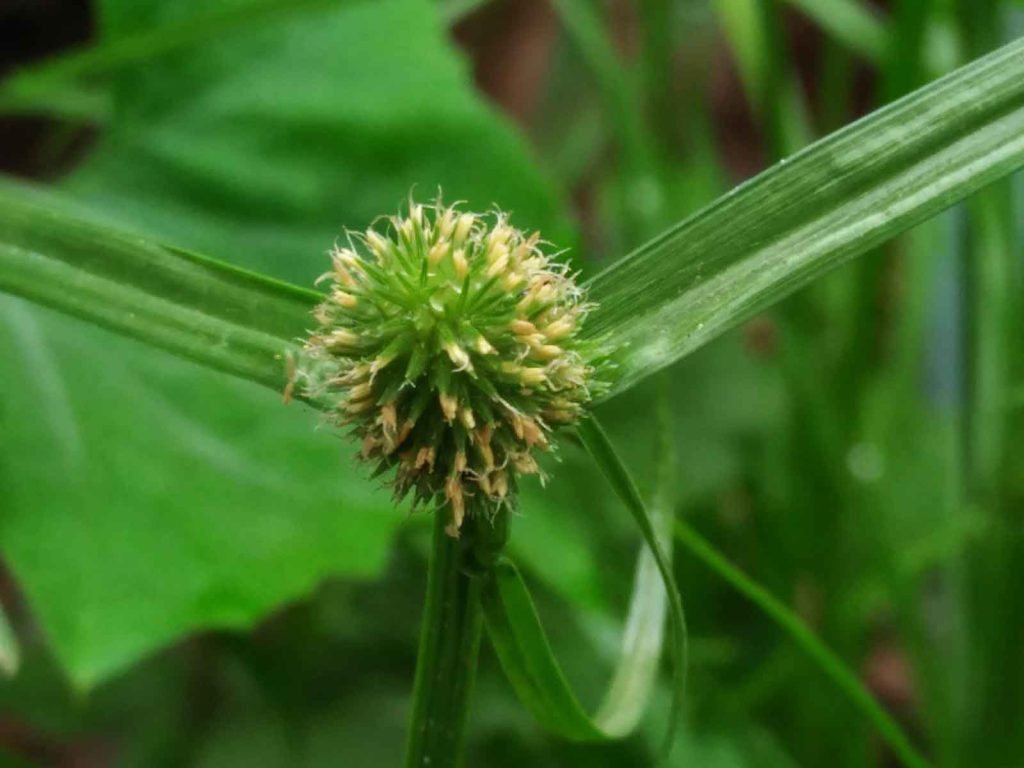
 One particular weed that is the bane of many gardeners is nutgrass. Because of its common name, gardeners can be confused about how it can be controlled. When you know its true name, you will know it is not a grass but a sedge. When I first noticed this plant in a friend’s garden, I thought it had a beautiful flower and took a picture of it so I could ask for it at the garden center. I am sure I made their day! Later, I came to know it for the thug it is and the difficulty in eliminating it from the landscape. Not only does it seed, but the established plant sends out rhizomes. The rhizomes are hidden underground stems that can continue to mature and send up a new plant even when you have pulled out the visible plant. There is also a nodule or “nut” at the base of the plant that stores energy to send up new shoots should the top growth be removed. It too often breaks off of the plant when pulled from above and will send up a new plant to replace that which was removed. Hand removal of sedges requires care to remove all underground tubers and rhizomes. This involves digging down and checking the base of the plant. If tubers and rhizomes are not removed new plants will emerge, and repeated hand-weeding will be required.
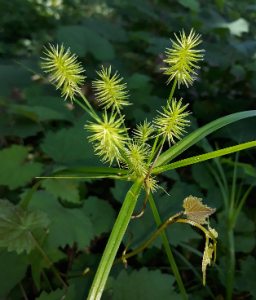 Sedges (Cyperus spp.) and kyllingas (Kyllinga spp.) tend to invade areas with excessive irrigation and/or poor drainage. Addressing this moisture issue will go far in solving your nutgrass problems. Sedges are most easily identified by their triangular stem. Sedges and kyllingas are similar in appearance and share the unique trait of being classified as neither a broadleaf nor grassy plant, which makes them immune to many of the common herbicides. To kill these tough invaders, you will need a specialty herbicide that kills the sedge but does not impact your turfgrass. Monument and Image are brand names for herbicides that will kill both nutsedge and Kylinga. Sedge Hammer is effective for nutgrass but is less effective on kylinga.
Become an intentional gardener. Know what you want to achieve in your bit of paradise. Know your plant’s habits and life cycle, and before you remove, remember to be able to name that child.
