
Throughout the holidays our thoughts often turn to gifts that we would like to bestow on our loved ones as well as those that are less fortunate than ourselves. If you love your garden, you can give it a gift as well, especially if it is unfortunate enough to be the victim of invasive species.
Invasive plants refer to non-native plants that have escaped into the “wild” and are now outcompeting and replacing native species. Kudzu, “The vine that ate the south”, is often given as an example of an invasive species. A thug, on the other hand, is a plant that thrives and aggressively spreads in your garden but is no threat to the greater environment. What is a thug in your garden may not present any challenges to your neighbor in their garden.
The gift is easy to bestow, just avoid planting known invasive species. It simply requires that you educate yourself to be aware of potential problem plants and to be able to identify any that may find their way into your garden so you can remove them before they become an issue. Simple enough it seems, but it can become confusing. Invasive species lists are created by state government agencies like the Tennessee Department of Agriculture. These agencies can ban the sale of a plant within the state. Environmental groups such as The Tennessee Exotic Pest Plant Council offers a more extensive list of invasive species. These statewide lists cover diverse growing conditions and some plants on the list may not be an issue in all parts of the state.
We do, however, know of several plants that are an issue here in the greater Memphis, TN area and should be avoided and eliminated. The two at the top of the list are Privet and Bradford pear trees. Both ornamentals were introduced for all the right reasons but have escaped into the wild and are a problem in the environment.
Bradford Pear is a beautiful white blooming ornamental tree that has outstanding fall color and an upright teardrop shape. This cultivar was developed to be sterile, thornless and have and tight upright teardrop shape. When young and raised in the nursery they were beautiful. Unfortunately, once in the residential setting as they matured, they did not perform well. The tight crotches of its strongly ascending branches were likely to break and often would split the tree in half when encountering heavy wind and rainstorms. The Bradford Pear is propagated by grafting the desirable tree onto the rootstock of the straight species. Once damage in a storm and cut down a new tree would often arise from the rootstock which was the straight species of the Callery Pear exhibiting all its undesirable attributes. The fruit of the straight species is spread by birds into the wild where it takes over fields and edges of woodlands. While the straight species is beautiful when in bloom the fragrance of its flower has been described as “rotting fish.” It also has three-inch-long thorns that can puncture tractor tires and a wide round shape.
It should be noted that there are no pear trees native to the U.S., although the species of pear trees grown for food (Pyrus communis, including d’Anjou, Bosc and Bartlett) these other pears do not become a problem the same way that the Callery species does. Some species are just more invasive and able to spread more easily than others. If you have a Bradford or a Callery pear and want to remove, be sure to kill the root to keep it from resprouting.
Good alternatives to the Bradford and Callery Pear include our native Serviceberry (Amelanchier arborea) selected cultivars, Amelanchier x grandiflora ‘Autumn Brilliance’, ‘Princess Diana’, and ‘Cole’s Select’ are also good selections with an abundance of flowers and excellent fall color.
Non- natives but which grow well here are the Cornelian Cherry (Cornu’s mas) with early spring yellow blooms and an exfoliating bark. ‘Spring Glow’ is a selection for southern landscapes. My favorite alternative is the Okame Cherry (Prunus x ‘Okame’) again this is a non-native but is one of the earliest spring bloomers that will be covered in pink blooms. Its growth habit is distinctively upright giving it a similar shape to the Bradford Pear.
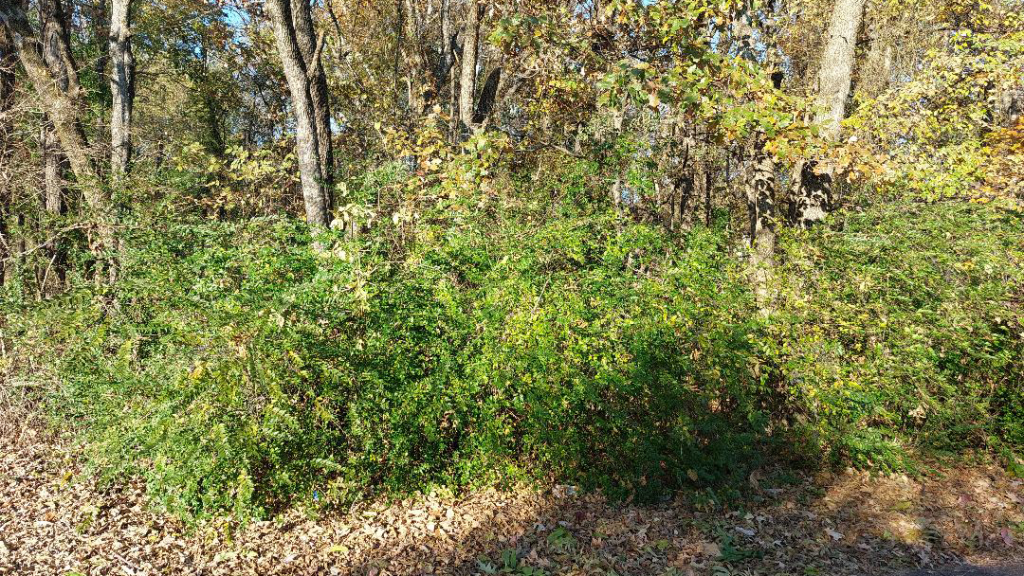
The other invasive plaguing Memphis is Chinese Privet (Ligustrum sinense) along with Common Privet (Ligustrum vulgare). Ligustrum are not native to the U.S. Privet was introduced to the US in the 1800’s for all the right reasons. It is a great ornamental plant used for hedges. It takes well to shearing and in Memphis it is semi-evergreen keeping most of its foliage through our mild winters. It adapts well to various light and soil conditions. It has fragrant white blooms that attract butterflies, and the birds love the dark black fleshy berries that it produces. The deer do not like privet to the point that it is considered deer-proof! Unfortunately, there are no predators or diseases to keep privet controlled. The birds spread the seed everywhere along with plant self-seeding as well as spreading by stolons. It often forms thickets replacing native species.
It is best controlled through removal. Like the Callery pear your efforts of removal are wasted if you do not kill the root. Small plants can be dug out pulled out by hand or with the help of a mattock. Larger plants can be cut repeatedly until the stored energy in its root system is exhausted. Treated with a systemic herbicide is another option. Treatments are most effective when applied in the late summer and autumn. Herbicide can be sprayed on foliage; however, I prefer the cut and treat approach as it uses far less herbicide. Just cut stems or trunks and to the remaining stumps apply a 25 to 35 percent solution of glyphosate. Stems should be cut close to the ground. Apply herbicide directly to the cut surface immediately after cutting. Delaying the application will reduce the effectiveness of the treatment. The herbicide can be applied with a sponge, paintbrush, or spray bottle.
Privet is banned from sale in TN. This includes the new introduction of Golden Ticket® Privet (Ligustrum x vicaryi) from Proven Winners which they are promoting as “the first non-invasive privet. The only sterile privet on the market.” (remember the “sterile” Bradford Pear?). If you see this plant offered for sale in TN, you should inform the seller and contact your local extension office to inform them of the violation.
There are a number of good alternatives to privet including Chinese Fringe Flower (Loropetalum chinense), Clereya (Ternstroemia gymnanthera), Bayberry (Myrica cerifera), Anise Tree (Illicium floridanum), Nellie R. Stevens Holly (Ilex ‘Nellie R. Stevens’)
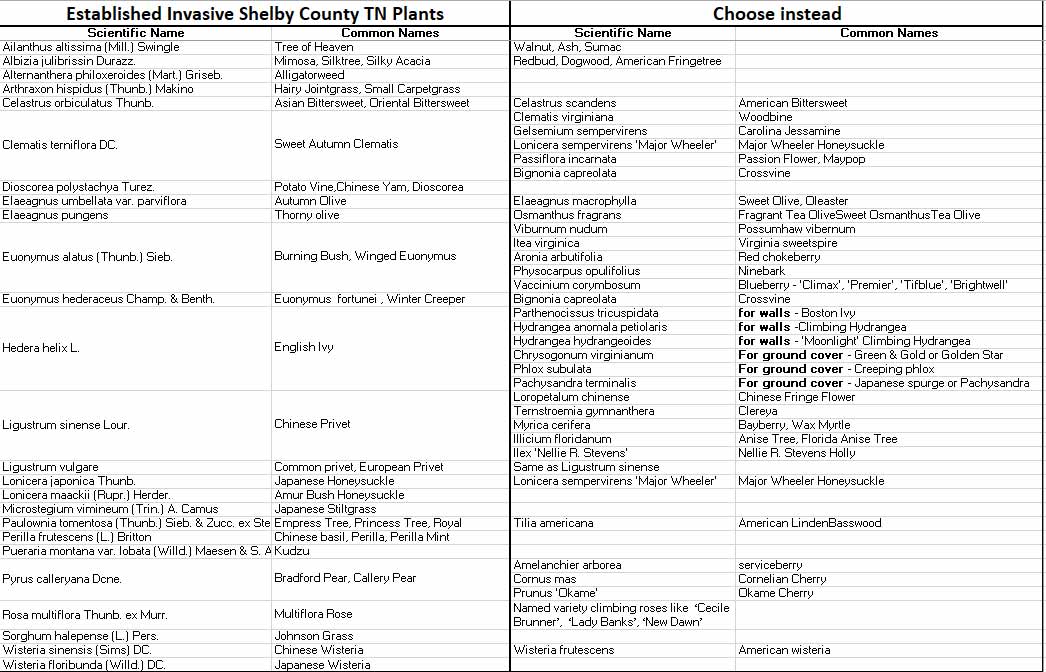
There are several other invasive species to be on the lookout for so take some time to educate yourself and remove any in your garden. Below is a list of some of the invasive plants in Shelby County. Many are still legally sold in plant nurseries. You may decide to remove these from your landscape. As a gift to yourself purchase a great new plant to replace the invasive plants in your garden.
.
December Garden Activities
Plant: Trees, woody ornamentals, tulips, and other spring flowering bulbs.
Lawn Care: Apply lime if indicated by soil test.
Prune: Collect garden greenery for holiday decorating. When pruning, cut back to a branch so as not to leave a stub. When cutting conifers, don’t go beyond the innermost needles. If you do, it may not regenerate form that point again. To extend the life of fresh-cut greenery, soak it in a bucket of water overnight to hydrate the leaves and stems before using.
Other: Look at the garden’s successes and failures and plan for next year. If no rain, water plants prior to a freeze. Protect tender plants by placing mulch or pine straw to depth of 6-8 inches (remove in spring). Consider recycling old Christmas trees or place in back of garden for wildlife habitat. While it may seem early, December can be a great time to order seeds for your 2025 garden, especially those you plan to grow as transplants. Clean, repair (if needed) and store your garden tools for next year.
Learn: Attend Bartlett Gardening University Saturdays at 2:30 PM, Bartlett Library 5884 Stage Road. Six consecutive weeks 1/11/2025 – 2/15/2025
