Dealing with the Dreaded Canna Leaf Roller:
A Late-Summer Battle Guide
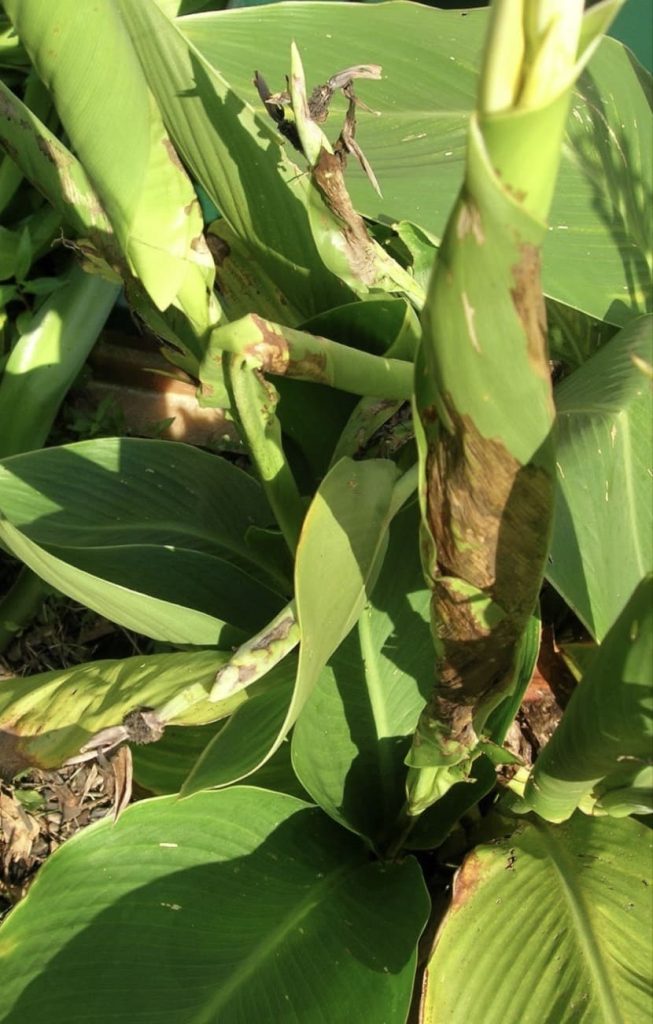
 If your mid-summer garden is anything like mine, your canna lilies are supposed to be the showstoppers right now. I absolutely love the striking, color-blocked blossoms and dark purple leaves of my ‘Cleopatra’ (Canna x generalis ) and the brilliant, tropical punch of my ‘Magic Pink’ (Canna indica) varieties. But as we roll through August in the Midsouth, you might notice something downright heartbreaking: ragged holes, shredded edges, and leaves tightly bound together with silk threads. I definitely have noticed them in my garden. Say hello to the canna leaf roller! If you are seeing this right now, don’t panic. You are definitely not alone, and we can still get our beds looking good again.
What Exactly is the Canna Leaf Roller?
The pests tearing up our beautiful tropical foliage are the caterpillars of the Brazilian Skipper or larger/lesser canna skipper butterflies (and specialized moths). These insects are native to the Americas, not invasive. However, because our canna lilies are non-native tropical imports, these caterpillars end up targeting our landscaped home gardens rather than supporting critical wild woodland food webs. Because they thrive in high heat, they migrate up from the Gulf Coast every summer, causing infestation and visible damage during August and September in the Midsouth, when it is too hot to regularly inspect all the plants in our gardens.
The Rapid 40-Day Life Cycle
Understanding the enemy’s timeline is the key to defeating them. The canna leaf roller completes its entire life cycle in only 40 days, allowing warm climates like ours to suffer through 3 to 4 overlapping generations per year. Here is how it happens:
• Eggs: Adult skipper butterflies lay tiny, pale green or whitish, dome-shaped eggs singly on the upper or lower surfaces of young leaves. They turn pinkish just before hatching.
• Larvae (The Rollers): Newly hatched, semi-transparent green caterpillars spin sticky silk threads to bind and roll the leaf edges tightly together. They live safely inside this tube, chewing the leaves from the inside out.
• Pupae: After growing fat on my ‘Cleopatra’ and ‘Magic Pink’ leaves, the caterpillar transforms into a bright green or pale chrysalis safely hidden within its protective leaf tube.
• Adults: Within 10 to 12 days, a fast-flying, brown adult skipper butterfly emerges with a very long proboscis to sip nectar, mate, and lay the next round of eggs.
What works -And What Doesn’t
 I’ll admit it: I tried dusting them with diatomaceous earth (DE), but it just didn’t do the trick. Because these caterpillars live entirely inside a sealed, waterproof rolled tube, powder barriers like DE rarely make contact with them. I also tried Bt (Bacillus thuringiensis). Bt is an excellent, wildlife-safe organic choice because it kills only leaf-eating caterpillars and won’t harm our local pollinators. However, the real secret to Bt is consistency. Because the sun breaks it down quickly and cannas grow rapidly in August, you have to apply it weekly and thoroughly spray it straight down into the unrolling center whorls. If you skip a week or two, the skippers will immediately take over again. I’ve learned that lesson the hard way.
Some suggest cutting the whole plant down to the ground since the plants grow rapidly. I am experimenting with that approach right now on several of my plants, but I’m not sure there’s enough time for them to regrow and flower before the cold weather moves in. Gardening is an experiment :).
I don’t use pesticides, but if you’re willing to try Carbaryl (Sevin), and pyrethroids (like bifenthrin or permethrin) be aware that they are highly toxic to bees, butterflies, and predatory wasps that touch the wet leaves. Even dried residue on the leaves can still harm the pollinators for several days after spraying.
Other systemic pesticides are proven to translocate the chemicals from roots and leaves into the newly developed floral systems, including the nectar glands and pollen grains. However, there is one systemic product I just learned about – chlorantraniliprole (Acelepryn SC)- a specialized systemic that targets the muscle receptors of chewing pests like caterpillars, but has an exceptionally low toxicity to pollinating insects. It can be bought online in 4 oz liquid bottle, but it is a bit more expensive.
August Action & Rescue Plan
• The Pocketknife Rescue: Grab a pair of pruners or a sharp pocketknife. Gently slice the silk threads holding the leaf rolls together. Unroll the leaf manually to expose the hidden pest.
• Hand-Pick and Squish: Drop the dislodged caterpillars into a bucket of soapy water, or crush them immediately.
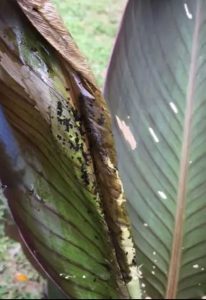
• Prune and Bag: If a leaf is completely devastated and filled with black insect frass (poop), cut the leaf stem off clean at the base. Do not compost it! Bag it up and throw it straight into the trash. I have never yet seen the caterpillar itself, but all the leaves I unrolled and cut off were full of frass.
• Invite the Beneficial Insects: Plant a border of Sweet Alyssum, Yarrow, Fennel, or Dill nearby. These open flowers provide easy nectar access for adult parasitic mini-wasps and predatory bugs, creating a permanent backyard security detail. I have never yet successfully grown Sweet Alyssum and Fennel, but I do have both Yarrow and Dill – I guess I’ll just need to plant more next year.
• The Crucial Winter Clean-up:
This is the most critical step! The insects overwinter as larvae or pupae in dead foliage. After our first hard winter frost, cut your cannas completely down to the ground. Rake up every single piece of dead leaf and stem and destroy it so you don’t start next summer at a disadvantage. You do not have to dig out the rhizomes. Mine have survived every winter for 15 years now with just a regular layer of mulch.
If you’ve successfully battled and won against this dreaded leaf roller, please let us know what worked for you. I’ll try to brave the heat and use Bt consistently during the next summer and will let you know.