
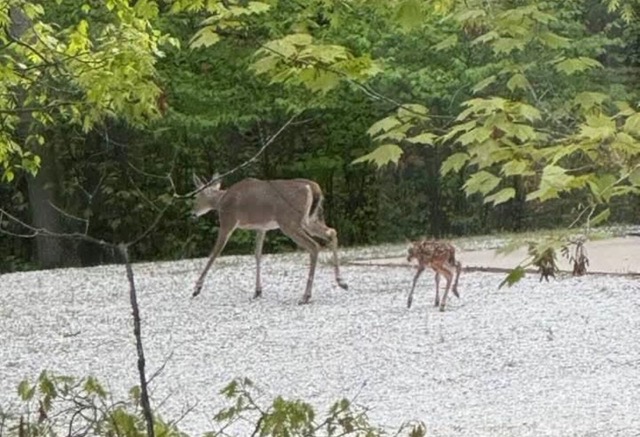
Walt Disney may have been an unintended conservationist. His portrayal of deer in the 1942 release of the animated film Bambi may have done more for the deer population in America than any other factor. After all, who would ever want to harm Bambi?
Once flourishing, the native deer population began to decline following the arrival of European settlers. The downward toll on the deer population continued until the early 1900s. According to the U.S. Forest Service, in the southeast states, the deer population declined to less than 215,000 during the early 1900s. Fortunately, by 1950, this trend was not only reversed, but populations had risen to an estimated 2.9 – 4.1 million, and in 2003 to 10.8 – 12 million. The current deer population size in the United States may now be greater than before European settlement!
In most areas of urban and suburban settings, deer are protected by hunting bans. Many homeowners find them adorable and put out feed to attract them to their property. Gardeners, of course, have a love/hate relationship with deer. Hate comes after they have eaten down all your hostas and roses. Yes, they are adorable, but the locally heavy populations in protected areas where we live allow them to prey on our beloved landscape plants.
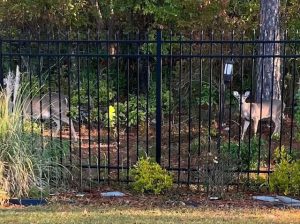 In the winter, their food is often scarce in the wild. In these times, the hungry deer see a landscaped backyard as a smorgasbord. If you have bird feeders, you will often find that they are also deer feeders. Once they have found your garden full of delights, they will continue to visit you season after season. In the spring, the does and fawns have high nutrition needs, and your garden is easy pickings. Come summer, deer are both hungry and thirsty. Your well-watered landscape is perfect for them. If you live in an area of Shelby County, TN, where deer are present, maintaining a colorful, lush landscape is a challenge. But there are ways to co-exist with the deer.
The only foolproof method of protecting your landscape from deer is through exclusion. You will need to fence them out and remember to latch the gate securely each time you enter or leave the protected area. There are several fence options, either alone or in combination. Some of these include.
- A woven wire fence 10 feet high. An adult deer can jump an eight-foot fence!
- A double fence. Two 4-foot-high fences built parallel to each other 3-4 feet apart. Deer are cautious about being caught between the two fences.
- Electric fencing, a 3-strand electric fence, with strands approximately 1 foot apart. To repel deer, aluminum tabs smeared with peanut butter should be placed along the middle strand. Deer are attracted to peanut butter, and when their noses or mouths meet the aluminum tab, they will receive a shock and will learn to avoid the area.
All other options are less effective. Scare tactics include dogs that will bark at the deer. However, you will need to be willing to keep your dogs outside, especially at dawn and dusk when deer typically feed. Motion sensor sprinklers can have some success, but deer can become familiar with them, and they lose their effectiveness.
Repellents may be scents that deer find offensive or which they associate with danger, like coyote urine. Some repellents are designed to be sprayed on plants to make them unpalatable to the deer. Any scent or taste repellents must be reapplied often as they diminish over time and can be washed away by rain. Repellents are often most effective at the perimeter of your property to discourage deer from entering.
A different approach is to try to co-exist with deer and learn to landscape with plants that will provide beauty, invite nature in, and not be consumed by the deer. While this means no sweeping Hosta beds, it does not mean that your landscape will be barren of color or texture. We must simply landscape with beautiful plants that deer prefer not to eat. Of course, there is no deer-proof plant. If a deer is hungry enough, it will eat anything to survive. The idea is to have the deer dine elsewhere on the plants they do enjoy and stay away from your garden.
Over the millennia, plants have evolved many strategies to survive being eaten by their predators. Some have developed toxins that are poisonous to deer, and they have learned to keep away from these. Some plants just taste bad to deer, have particularly sharp thorns, or a texture they do not like.
In general, deer do not like fuzzy-leaved plants like Lamb’s ear. Deer have an excellent sense of smell and can get confused when overstimulated by aromatic foliage or flowers. Salvias, alliums, and rosemary are good examples. Leathery or fibrous textured foliage is also unpalatable think ferns and ornamental grasses. Spiny and bristly plants such as barberry and Yucca are also left alone. By using these types of plants in our landscapes, we deter deer from browsing. Let your neighbors plant deer candy.
| Deer Candy Avoid These Plants | ||
| Hosta | Summer Phlox | Cardinal Flower |
| Daylily | Cosmos | Arborvitae |
| Hydrangea | Sweet Potato Vine | Magnolia |
| Lily | Sunflower | White Pine |
| Rose (except rugusa rose) | Tulip | Yew |
| Solomon’s Seal | Petuna | Crab Apple |
| Azalea | Annual Phlox | Vegetables |
| Clematis | Coleus | Fruits |
| Landscape With Plants Seldom Damaged by Deer | ||
| Woody Ornamentals | Herbaceous Perennials | |
| American holly | Amsonia | Lamb’s ear |
| Barberry | Anemones | Lavender |
| Birch | Angelica | Lemon balm |
| Boxwood | Anise-Hyssop | Lily-of-the-valley |
| Japanese pieris | Astilbe | Lungwort |
| Chinese junipers | Baby’s breath | Mullein |
| Chinese holly | Balloon flower | Ornamental onion |
| Sassafras | Barrenwort | Ostrich fern |
| Forsythia | Beebalm | Oriental poppy |
| Honey locust | Bergenia | Painted daisy |
| Kousa dogwood | Bishop’s weed | Pennyroyal |
| Red Twig Dogwood | Bleeding heart | Peony |
| Beautyberry | Boltonia | Primrose |
| Weigelia | Bugbane | Purple coneflower |
| Herbs | Bugleweed | Ribbon grass |
| Parsley | Buttercup | Royal fern |
| Sweet basil | Candytuft | Russian sage |
| Garlic chives | Christmas fern | Scilla |
| Mint | Cinnamon fern | Sensitive fern |
| Oregano | Columbine | Shasta daisy |
| Rosemary | Coreopsis | Snowdrops |
| Sage | Crown imperial | Soapwort |
| Thyme | Daffodil | Spike gayfeather |
| Annual / Biannual Flowers | Dead nettle | Sundrops |
| Ageratum | Evening primrose | Sweet William |
| Blanket flower | False indigo | Sweet Woodruff |
| Blue salvia | Feverfew | Turtlehead |
| Cleome | Forget-me-not | Tussock bellflower |
| Castor Oil Plant | Foxglove | Wisteria Wood fern |
| Dahlia | Globe thistle | Wormwood |
| Dusty miller | Goatsbeard | Yarrow |
| Four O’clock | Goldenrod | Yucca |
| Heliotrope | Hellebore | |
| Marigold | Jack-in-the-pulpit | Ornamental Grass |
| Morning glory | Jacob’s ladder | Fountain Grass |
| Poppy | Japanese pachysandra | Sweet Flag |
| Sweet alyssum | Japanese painted fern | Switch Grass |
| Verbena | Joe-pye weed | Morrow’s sedge |
| Wax begonia | Kirengeshoma | Hakone Grass |
| Zonal geranium | ||
