

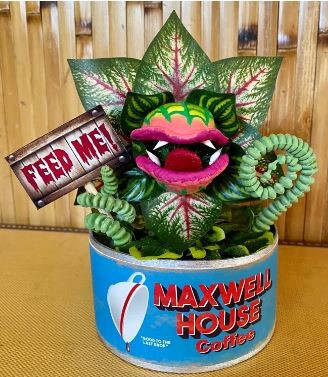
In the theatrical version of Little Shop of Horrors the meek flower shop assistant Seymour must feed a plant in order for it to grow big and strong. The problem is that it responds best to a diet of human blood! You can imagine that this results in unfortunate consequences. As the play ends, the Chorus in Little Shop of Horrors sings “Don’t Feed the Plants”.
As gardeners we can relate to the desire to see our plants grow big and strong and we turn to fertilizers to assure we are giving them every advantage for success. But what if we heed the advice given in the play and we don’t feed the plants? The good news is that if we don’t feed the plants they will do just fine. We can push plant growth and the yield of crops however by supplementing the soil with fertilizers. In fact large scale use of chemical fertilizers only came into broad use following world war two. Prior to that time farmers used natural fertilizers like manure on their fields. And urban landscapes seldom used any supplemental nutrition on their lawns or ornamental gardens.
We assume our plants want to be fed. However if you love your plants first find out whether they need to be fed at all and if so what nutrients they need. Do this by conducting a soil test every 3-5 years. You can get a test kit and instructions from the Shelby County Extension Service at the Agricenter. The exception to this is your potted plants growing in potting soil. A good quality potting soil will drain well but also hold onto water. To achieve this these products generally contain a good amount of peat moss. Most are sterile (no microbial life) and have little to no nutrients. You are correct in thinking it is necessary to fertilize your pots. A slow release chemical fertilizer is your best option for this task.
It is important to know that when we fertilize we are not actually feeding our plants. We are feeding the soil, from which the plants take their nutrition. The two primary types of fertilizers can be classified as Chemical and Organic. A balanced chemical fertilizer contains the three primary nutrients need by plants Nitrogen (N) Phosphorus (P) and Potassium (K). The three numbers on a bag of fertilizer indicate the percentage of that nutrient in that fertilizer and are always listed in the order of N, P, and K.
Chemical fertilizers are in a form, that when it comes in contact to water, plants can use immediately. The chemical dissolve in water to be taken up by plant roots. Because of their immediate availability they should only be used when plants are actively growing. Use at any other time would be of no benefit to the plant. Early spring (Feb/March here in Memphis) is a great time for general fertilization of plant beds with a chemical fertilizer. Avoid using them after August on your perennials which are those plants that come back each year. Chemical fertilizers tend to promote new growth and our perennial plants need time to harden off and prepare for winters rest.
Chemical fertilizers are potent and should be used only according to label directions. If anything, you should under apply chemical fertilizers. Nitrogen and Potassium are highly mobile in the soil but our plants can only use them in a limited amount. Phosphorus has limited mobility and in our heavy soil here in Shelby County TN. It rarely needs to be added to our soil. Avoid over fertilization with a chemical fertilizer as excess fertilizer is easily leeched into our ground water resulting in pollution of our waterways. It can also burn the roots of plants and cause them to decline.
If you use a chemical fertilizer look for one that is time released. These fertilizers are specially formulated so that the nutrients are released slowly over time. They feed the plants with multiple meals rather than one belt busting feast. Slow release also limits run off.
The other form of fertilizer is organic. Organic has many definitions but for this discussion we mean “The decayed matter from a once-living organism”. It is known by many names, compost, humus, aged manure and leaf mold. You can make your own, purchase it in bulk at mulch and stone yards, or buy it in bags at the garden center labeled as organic fertilizer. In addition to dry you can get liquid versions such as fish emulsion. Organic fertilizers have low N,P,K levels so it is impossible to over fertilize. They can be applied at any time of the year.
Organic fertilizers are very forgiving because of how they work. They do not have any nutrients that are immediately available to the plant. The material must be further broken down by soil microbes which use it as a food source. Their waste contains the nutrients in a form that can be taken up by the plant roots. This is how mother nature has done it since time began. Dead matter on the soil surface is decomposed by the soil food web (bacteria, fungi, insects, nematodes, worms) and their waste delivers nutrients to the plant in a usable form dissolve in soil moisture.
Organic fertilizer materials can simply be spread on the soil surface and nature will cycle the nutrients into the plant root zone. Alternatively, if you are looking for a workout, you can incorporate the organic matter into you soil. This will give you a more immediate impact but it will also work against you by disrupting your soil structure. In an ornamental bed it can also disturbing plant roots. In my opinion I would avoid working it into the soil unless it was a new bed or a vegetable bed. But being lazy I personally would just broadcast it over the surface and let the worms do the tilling for me.
It is hard not to see the beauty that a well-manicured lawn lends to a landscape. And if you are a lawn lover then you are likely a big user of chemical fertilizers to assure a thick healthy lawn. With as many as seven applications of fertilizer a year coupled with weed control chemicals a beautiful lawn is assured. A healthy turf will deter weeds and look beautiful but you can achieve nearly the same results with as few as two applications of fertilizer a year. More fertilizer than this means more frequent mowing, more watering and more expense. Heavy fertilization leads to rapid growth and clippings that must be collected to prevent thatch build up.
There are many alternatives to a pristine turf lawn but perhaps the easiest approach t is to simply forgo the chemicals and just mow what grows. When you mow use a mulching mower and leave the clippings and chopped leaves in the lawn you are essentially applying an organic fertilizer to feed the soil with every mowing. Take Seymour’s advice ‘Don’t feed the plants’ and enjoy the wild flowers that will sprout among the grass.
