
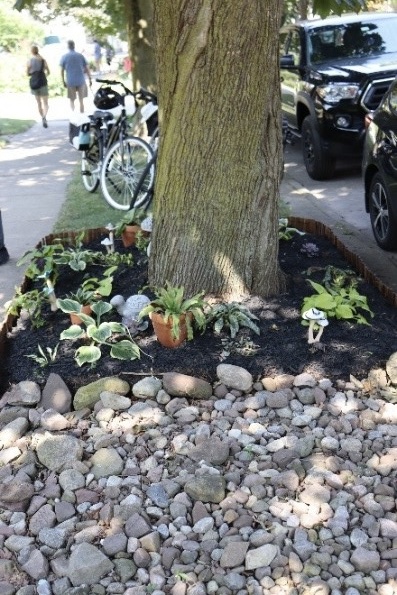
Heavenly Hellstrips
Author: Tom Rieman, April 2026
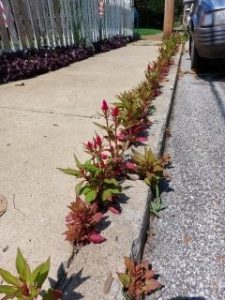 Where I grew up in Northwest Ohio, the city would plant a tree in front of every house in the strip of lawn between the street and sidewalk, so we always referred to this bit of the landscape as the “tree lawn”. You may call it by a different name, perhaps verge, median, boulevard, berm, curb lawn, parkway, or parking strip. I have come to understand that what you call this area is governed by regional dialect. The colorful name for this area is “hellstrip,” which seems appropriate because this no man’s land between street and sidewalk, is plagued by reflected heat from pavement, poor soil structure, foot traffic, pet droppings, litter, cars running over the curb or backing over the area, as well as a Sahara like aridity that hoses and sprinklers can’t quite reach. Adding insult to injury, you don’t own it, but you are responsible for its maintenance. Because it is a public right-of-way area, it is often used for utilities, and they can dig it up any time they see fit. However, in Tennessee, utility companies are generally required to restore easement areas to their original condition, or a reasonably similar state, after completing work.
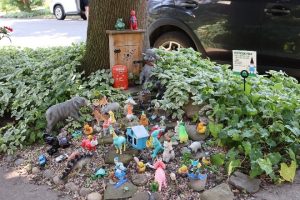 Because our hellstrips are a public space where neighbors pass by and visitors arrive, we want it to look good. Most folks just leave it as a grass strip, but this can be high maintenance, requiring frequent mowing, edging, feeding, and watering to keep it looking its best. There are many lower maintenance options you may want to consider, but be sure to think it through to get the best option for your particular situation.
Before you get too invested in your idea to upgrade your hellstrip, check with your municipality and homeowners association for any codes that may restrict what you can plant or place in your hellstrip. If your plan involves any sort of digging or excavation, call 811 first so they can locate underground utilities for you (this is a free service).
So what can we do with this difficult area? There are several options based on your budget, location, and acceptable level of effort needed to maintain the look.
- Lawn – This is the option many choose, but it is far from a low maintenance choice. It is a long and narrow lawn, requiring a lot of time to edge it to keep it looking tidy. Mowing is another consideration, especially if you live on a street that is busy with traffic. And of course it will require water and feeding to keep it looking its best.
- Paving – Some folks choose to pave over their hellstrip with concrete, gravel, brick, or stone. Problem solved, but remember, doing this may be seen as an open invitation for folks to park on your hellstrip. For a similar look a planting of monkey grass or mondo grass would be a permeable alternative to the paving. It has the advantage of being evergreen, low growing, and low maintenance. These tough plants outcompete weeds and look good.
- Garden – It sounds counterintuitive to plant this area as a garden, but with the right plant choices, once established, this can become the welcoming entry you envision and enhance your home’s curb appeal.
In designing your hellstrip garden you should consider its special needs. Remember to respect sight lines. You don’t want plants that will block your view of oncoming traffic when pulling out, or pedestrians when pulling into your driveway. Pedestrians will feel safer if they can see over the planting. A good rule of thumb is to choose plants that at mature height are under 30 inches.
I hadn’t done my research before I created my hellstrip garden and I made the mistake of planting from sidewalk to curb. This normally isn’t a problem on my quiet street but when we have large groups over or when there is a need for street parking during events at a nearby park it becomes an issue. Passengers exiting must thread their way across the garden or trample over my plants. I can’t get upset if a plant is damaged since it my own fault. What I should have done was to plan for street parking adjacent to my hellstrip by leaving a 15” gap at the edge near the street so passengers can open their door and exit the car.
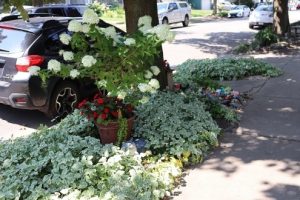 To create your hellstrip garden, remember that the soil is likely compacted clay with a fair amount of debris mixed in from the original construction of your home, sidewalk, and street. If you want to assure the success of your garden, you will want to address this in one of three ways.
- Option One – Amend the existing soil by digging it up to a depth of at least 12 inches and mixing in organic matter.
- Option Two – Turn the garden into a raised bed by covering it with several inches of a quality garden mix from a local mulch yard. Now plant your selections into this.
- Option three – Use a collection of pots or other containers in which to plant. This is a no dig option and will help protect plants from pets.
Make sure your pots are held above the soil using bricks or similar material to provide for proper draining, this prevents roots from growing through the drain holes and plugging up your drain. It also deters critters from burrowing into your pot.
A livestock water trough can be filled with water and planted with water plants both annuals like water hyacinth and perennials such as hardy water lily, Saururus cernuus LIZARD’S TAIL, Pontederia cordataPICKERELWEED, Carex oshimensis ‘Evergold’, and Iris brevicauli LOUISANA IRIS to namE a few. Toss in a few mosquito minnows which the Shelby County Health Department will provide free of charge, and you are all set for several weeks before you will need to add water if there is no rain.
 To make good plant choices, you should choose plants that can thrive in the tough conditions of a hellstrip especially if watering is going to be a problem.
Succulents – Often the first thought for drought resistant plants, succulents will require good drainage, which we don’t have in our area, so it calls for planting in containers, raised beds, or amending our soil. Consider Sedums, which come in a vast array of colors and textures or Hens and Chicks (Sempervivum). Larger plants to evaluate are, Prickly Pear Cactus, Red Yucca (Hesperaloe parviflora), and my favorite Color Guard Yucca (Yuca filimentosa ‘COLOR GUARD’) for its year round interest. Of course, prickly, pointy plants near pedestrians may not be a good idea.
Flowering Perennials – There is a wide selection of tough flowering perennials from which to choose, including Euphorbia, Bee Balm, Lavender (requires excellent drainage), Daylilies, Iris, Russian sage, Penstemon, Black-eyed Susans, Agastache, Coneflower, Gaillardia, Arkansas Bluestar (Amsonia hubrichtii), Salvia, Yarrow, Liatris, Phlox, and Coreopsis.
Ornamental Grasses – Here are a few dwarf ornamental grasses suitable for your Memphis, TN area hellstrip.
- Briza media (Quaking Grass) Clump forming, spreading grass with thin 1/2″ foliage to 15″ tall. Flowers tower over the foliage to 36″. Tiny seed heads develop, which dangle from a thin thread and move with the slightest breeze, from where it gets its name.
- Chasmanthium latifolium (Northern Sea Oats) – Very attractive arching green foliage and seed heads. Seed heads turn gold in the fall.
- Equisetum – Horsetail Reed – Evergreen perennial, spreads rapidly by underground runners. Likes full sun, good marginal plant. Likes wet locations, grows to 4′. Occasionally, a dwarf form is available. Very, very invasive. Should only be grown in a water garden or escape proof container.
- Miscanthus sinensis ‘Dixieland’ – A dwarf variegated form to 3′ tall. Purplish flowers to around 4′
- Muhlenbergia (Muhly Grass) – Grows best in sunny, sandy soils, it tolerates poor soils and light dappled shade. Trim in late winter
‘Regal Mist’ – A selection with deeper pink flowers
‘White Cloud’ – White flowers
- Cenchrus alopecuroides (Previously known as Pennisetum alopecuroides) ‘Hameln’ 24” dwarf variety of fountain grass. Very attractive tubular ’foxtail’ like flower head. Cut back in late winter/early spring. ‘Little Bunny’ is an even smaller dwarf version at 12” height.
- Pleioblastus variegatus (Dwarf Whitestripe Bamboo) while it can be a thug in the garden it is well contained in a hellstrip.
Trees – The tradition in my hometown of planting a tree in this strip made for beautiful tree lined shaded streets. I don’t know if the idea was intended to cause drivers to be more cautious while driving due to the trees that encroached on the street, or if it was just a questionable design practice that was a holdover from the horse and buggy days. I have several concerns with this practice. The tight space meant that trees overhung the street, and if they were not maintained, the traffic would keep them pruned back as they brushed against the branches as they traveled down the street. The tree roots were left to find their way through compacted soil under the street and sidewalks resulting in weaker trees with shorter life spans. These roots are prone to lift sidewalks and damage the street over time. As evidenced by the missing bark on trunks many of the trees were involved in dangerous collisions with cars.
If you must have a tree you will need a tree that will not outgrow its space. Good selections would be columnar trees or smaller ornamental trees. Smaller varieties of crepemyrtle are a popular choice. The better choice may be to plant the tree 30 feet from the curb.
Shrubs – There are any number of shrubs that can be planted in the hellstrip. If you are not on a busy street you can consider a knot garden using boxwood or a dwarf small leaf holly like Ilex crenata ‘Soft Touch’. Ground cover shrubs Juniperis procumbuns ‘Nana’ performs well here in Shelby County in full sun to partial shade and is about 1 foot tall. An even lower grower is blue rug juniper, Juniperus horizontalis‘Wiltonii’ with a silver-blue evergreen foliage, mature height of just six inches. One plant will spread outward six to eight feet.
Flowering shrubs or shrubs with colorful foliage are also options. Just make sure you are choosing a variety that will not outgrow its space or you will be sentencing yourself to an eternity of pruning. Spirea, Weigelia, Abelia and even some of the new dwarf Hydrangeas for shady spots or the Panicle Hydrangea for sun.
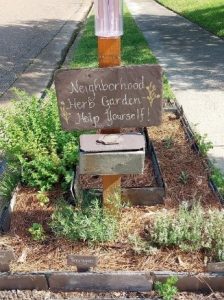
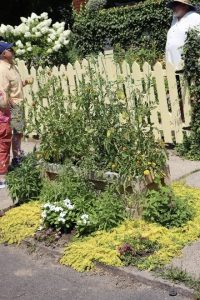 Edimentals – If you want a landscape you can eat consider mixing into your design Kale, Swiss chard, or Parsley for the cool months. With excellent drainage, you can enjoy Rosemary, Lavender and Sage. Perhaps an entire herb garden to share with neighbors. There are no rules against other vegetables like tomatoes, peppers etc. as long as you can accept the fact that pedestrians will be taking samples home with them.
Bulbs – The use of bulbs in the landscape shouldn’t be overlooked.
Camassia – late spring bloom
Crocosmia – Crocosmia, Summer bloom
Crocus sativus – Autumn Saffron Crocus, Fall bloom, each bloom contains three threads of saffron;
Eucomis hybrid – Pineapple Lily, Summer Bloom
Leucojum vernum – Spring Snowflake, Spring bloom
Lycoris radiate – Red Spider Lily, Late summer to early fall bloom
Lycoris squamigera – Naked Ladies, Late summer to early fall bloom
Muscari spp. – Grape Hyacinth, Spring bloom
Narcissus Daffodil – Spring, Varieties that do well in the south include
- Ice Follies: Large, early-blooming white/yellow.
- Tete-a-Tete: early-blooming fragrant buttercup-yellow petals and yellow-orange cups. With 2 to 3 flowers per stem
- Carlton: Large-cupped, two-tone yellow flowers and a vanilla fragrance.
- Erlicheer: highly fragrant, double, white and yellow, gardenia-like flowers in early-to-mid spring.
- Thalia: All white, fragrant bloom, with 2-3 nodding flowers per stem and ivory petals. Mid season bloom
- Keverne: all yellow, long lasting large cup, strong performer. Early to mid season bloomer
Zantedeschia spp. Calla Lily, Late Spring
Zephyranthes candida Rain Lily, summer – fall, blooms following rain
As with so many things in life, the choices are endless but whatever will enjoy, and be proud is the best solution for your hellstrip. The secret is to garden with intention. Know what is important to you, what will bring you happiness, then create it.
