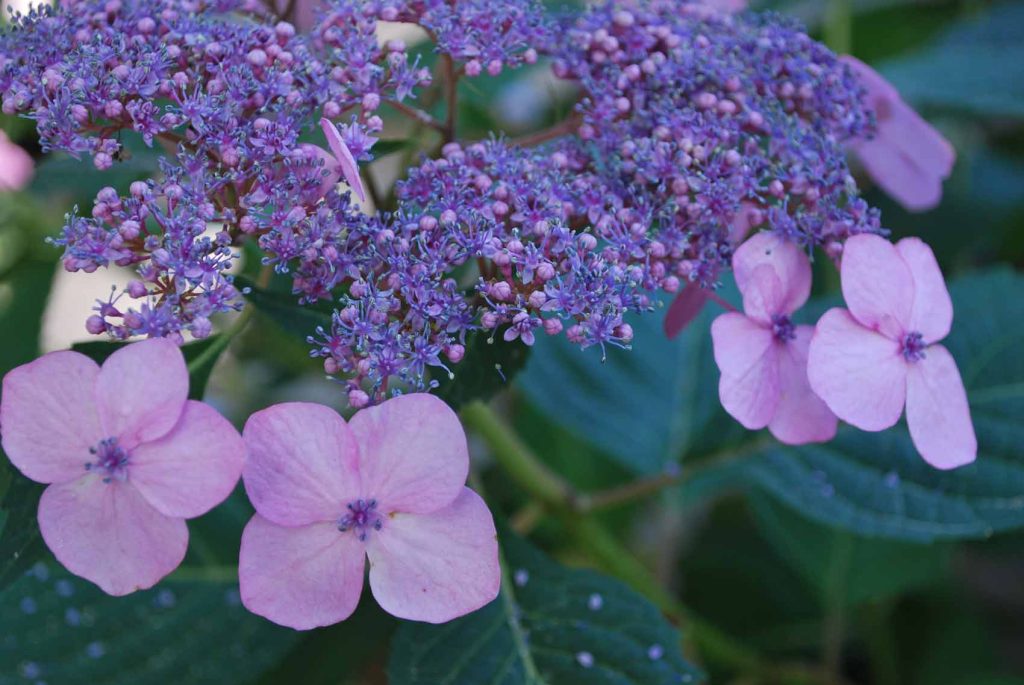
Hydrangeas: types and care
Book source: Success With Hydrangeas – Lorraine Ballato
Common Hydrangea Species
Hydrangea macrophylla – Big leaf, Hortensia, Mophead, French, Lacecap
Hydrangea arborescens – Smooth / Woodland
Hydrangea quercifolia – Oak leaf
Hydrangeas paniculata – Panicle, Pee Gee
Hydrangea petiolaris – Climbing
Hydrangea macrophylla – Big leaf hydrangea
- most popular species; native to Japan and Korea; tolerates salt air
- two flower forms : snowball and lacecap (flat but fertile flowers for pollinators)
- needs morning sun and afternoon shade;
- for older varieties: aluminum in acidic soil (low pH) will make flowers blue- apply elemental sulphur or iron sulfate or aluminum sulfate to lower soil pH;
- alkaline soil (high pH) will make flowers pink (aluminum is tied up and is not available for plant roots in high pH), add dolomitic lime in fall for pink flowers the following year
- fertilizer with high phosphorus will tie up aluminum in the soil and prevent blue color from forming
- newer varieties are not pH sensitive and will not change color depending on aluminum in soil
- Pruning:
- Older varities (before 2004) bloom on old wood (stems that were grown in previous years) and form new flowering buds in August and September in the Southeast – no pruning after August ; newer varieties can bloom on new (stems grown during the current year) and old wood
- Remove dead, diseased and damaged canes at any time
- Wait until late April to remove stems with “dead” tips
- Remove crossing/rubbing branches
- Remove faded and spent flowers right after flowering, cut down the stem as far as needed
Hydrangea arborescens – Smooth/Woodland hydrangea
- native to woodlands in the eastern US; leaves: matte, thinner and floppier
- “Annabelle” the most famous variety; “Haas Halo” – most pollinators
- Very winter hardy – leaves have long petioles
- Spreads more in width than in height
- Two flower types: snowball and lacecap (great for pollinators)
- Needs morning sun and afternoon shade; moist but well drained soil
- Cannot manipulate flower color with soil pH
- Blooms on new wood- prune in late winter as far down as necessary
Hydrangea quercifolia – Oakleaf hydrangea
- native to southeastern US; woodland settings; zone 5-9
- Leaves become red in the fall
- Panicle shaped flowers start white and age to pink; they open from the bottom
- Cannot manipulate the flower color with soil pH
- Needs morning sun and afternoon shade; moist but well draining soil; mulch
- Blooms on old wood; prune right after flowering but not after August/September
Hydrangea paniculata – Panicle / Pee Gee hydrangea
- native to Southeast Asia
- Panicle shaped flowers ; cannot manipulate flower color
- Very cold hardy; moist but well drained soil
- Blooms on new wood – prune in late winter as far down as needed
- Some are shaped as trees or lollipops
- Can take more sun than other species (but not the best in full summer sun)
Hydrangea petiolaris/ Schizophragma hydrangeoides – Climbing hydrangea
- native to Japan; vigorous shade tolerant climber; aerial rootlets; needs strong support
- Fragrant cream colored lacecap flowers
- Cinnamon color exfoliating bark;
- Shade or part shade; moist well drained soil
- Blooms on old wood; prune right after flowering but not after August/September
- Flower color does not respond to change in soil pH
Fertilizing – Less is more. NPK ratio 3-1-2 is best (for example,12-4-8). Fertilize only from March to August. Organic fertilizers are slowly released and better absorbed with no waste. Consider compost.
Water -Water deeply and infrequently. Macrophylla will droop when in the sun for several hours – it does not necessarily mean it needs to be watered. Mulch.
Fungal diseases (can only be prevented, but not cured) – fungus spores come on the wind. Look for products with active ingredients: hydrogen peroxide, Neem oil, Bacillus subtilis, or potassium bicarbonate. Copper based products may be effective short term but have long term consequences.
Cercospora Leaf Spot – end of summer; remove diseased leaves from plant and soil.
Bortrytis (gray mold) – remove infected leaves and flowers
Anthracnose – big round sunken spots on leaves and flowers; remove leaves
Powdery mildew – likes warm but dry conditions with high humidity
Rust – small orange spots on underside of leaves; remove leaves