
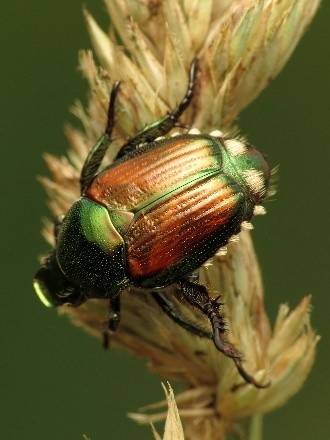
June Brings Garden Jewels
Each June, here in the mid-south, our gardens are likely to be bejeweled by beautiful metallic jade and gold Japanese Beetles. These beauties will feed on the foliage plants, turning them into leaves of lace. You may find that their feeding habits result in a work of art!
Most gardeners, however, think of these jewels as pests and want them to stay away from their ornamental plants. Japanese beetleswere accidentally introduced to the United States in 1916 in New Jersey as stowaways on nursery stock. They now inhabit most of the Eastern states except Florida and are continuing to move westward. In my Memphis, TN garden, they were not much of an issue until about 2010, but since then have reliably shown up every June.
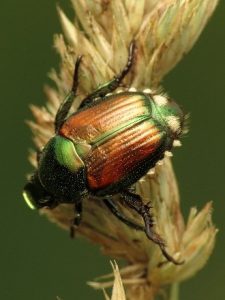 Japanese beetles feed on the leaves, flowers, and fruits of over 300 species of wild and cultivated plants. Their preferred hosts include crape myrtle, rose, zinnia, marigold, canna, hibiscus, dahlia, raspberry, and Virginia creeper, as well as trees like linden, crabapple, elm, birch, and maple. The good news is that Adult Japanese beetle damage usually affects only the appearance of plants. Healthy, mature trees and shrubs can tolerate a lot of feeding without significant, long-term injury. While healthy roses will survive Japanese beetle feeding, their blossoms are often ruined by the insects.
We notice these jewels in their adult form when they emerge and begin feeding on our plants. The adults have a brief four to six-week bacchanal frenzy of feeding and sexual debauchery as they race to produce their next generation. After mating, females tunnel one to three inches underground in the soil to lay eggs. This will occur several times with each female laying up to 60 eggs.
The eggs hatch as grubs in about two weeks. The grubs go through three different growth stages (instars) during the summer,becoming progressively larger with each stage, feeding mainly on the roots of lawn grasses. When grub feeding is severe, dead patches of grass develop. These dead patches can be rolled back like a carpet due to the lack of roots. If grubs are not found, examine the still living turf at the edges of damaged areas for their presence. Healthy turf grass can typically tolerate up to 10 grubs per square foot. Fortunately or perhaps unfortunately, grubs are a favorite food for moles. When mole tunnels are near the surface,they can lift your turf, separating the grass roots from the soil and resulting in the same issue of dead turf. Many birds also find the grubs tasty and help in their control.
You won’t eliminate Japanese beetles from your landscape as long as you have plants they will feed upon. However, if you are interested in controlling the population of Japanese beetles to limit their damage, there are several actions you can take. Perhaps the easiest control method is to handpick or knock the beetles into a bucket of soapy water to kill them. In a small landscape, this can be the easiest and best method. It is best to do this in the morning or evening when the temperature is cool, as they will fall off your plant when you flick them with your fingers instead of flying away. I find this sport to be oddly satisfying and will compete with my wife for the highest number caught in a single outing.
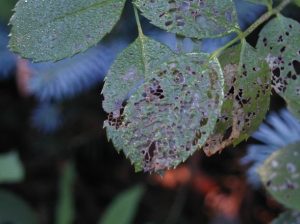 You can employ their ability to detect scents in your battle against Japanese beetles. The smell of dead beetles repels living beetles.Use this to your advantage by placing containers of trapped or handpicked beetles near your desirable plants. Because beetle-damaged leaves emit airborne chemicals that attract more beetles, you’ll reduce the number of new beetles attracted to your plants by physically removing these damaged leaves. The female Japanese beetle produces a sex pheromone for mating that is highly attractive to males. Traps were developed by using synthetic female sex pheromones and a blend of chemicals with a strong floral odor to draw the beetles into the trap, from which they can’t escape. These were developed only to monitor for the presence of Japanese beetles. They are highly effective but are not recommended as a control method. Research at the University of Kentucky has demonstrated that more beetles fly toward the traps than are caught. This usually results in more damage to your garden and landscape plants than if no traps were present.
If you are developing a new landscape or adding to an existing one, use plants in your design that are not preferred by Japanese beetles. Consider including boxwood, clematis, chrysanthemum, conifers (e.g., arborvitae, spruce, fir, pine), daylily, geranium, ginkgo, forsythia, magnolia, oak, white poplar, redbud, azalea, rhododendron, and yew.
In some cases, fine netting can protect plants from beetle damage. However, do not cover plants in bloom that require pollination (e.g., fruits), as this will prevent pollinators from reaching them.
Products containing pyrethrins are somewhat effective contact insecticides, provided they are sprayed directly on the insect. Repeat applications are necessary. Avoid spraying bees and beneficial insects as these products are toxic to these non-pests as well.
Neem oil is effective for several days, but repeat applications are necessary. Neem oil helps deter Japanese beetles but is less effective when large numbers are present. This product is low risk to bees and other beneficial insects.
Several effective, longer-lasting insecticides are available for treating Japanese beetles. Chlorantraniliprole (Acelepryn®) provides two to four weeks of protection and is low risk to bees.
In theory, by controlling grubs in your lawn, you will reduce the number of Japanese beetles on your plants. However, controlling Japanese beetle grubs is unlikely to reduce the number of adults on landscape plants. Beetles from non-treated grass areas, most likely your neighbors, can fly long distances to preferred adult food plants. It is recommended that you treat your landscape for grubs only if they are causing lawn damage.
Another June garden jewel is the bagworm. Not as colorful as the Japanese beetle, but quite decorative, they hang on your plants like prisms on a crystal chandelier. Bagworms love our arborvitae here in Memphis, TN, and are one of the many reasons I recommend they be avoided as a landscape plant here. They are also the most common insect pests of our juniper, cedars, and other needle-bearing evergreens. Heavy infestations can cause total defoliation,killing the plant.
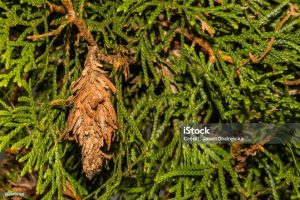 These silken bags are spun by caterpillars. The bag expands as thecaterpillar grows. The silk bag is covered with pieces of foliage from the host plant for camouflage and protection. At maturity, the caterpillars pupate. The adult winged males leave the bag to mate with the adult females, who never leave their bag. The femalessimply deposit their eggs inside the bags and die. Bagworm eggsoverwinter inside these bags, which hatch the following spring.
Removing the bags by hand is a good control option for small trees with light infestations. For heavy infestations or large plants, spray with an insecticide containing spinosad, a natural substance made by a soil bacterium that can be toxic to insects. Spinosad product works on many different types of insects (caterpillars, flies, thrips,and beetles) but spares most beneficials such as lady beetles, predacious fly larvae (hover flies and midges), most parasitic wasps, lacewings, spiders, predatory mites, and bugs.
Because there is only one generation per year, proper spray timing is the key to good control. For best control, apply sprays shortly after eggs have hatched in the spring and before caterpillars have grown large enough to cause significant damage. Avoid spraying with products like carbaryl, malathion, acephate, or pyrethroidinsecticides (permethrin, cyfluthrin, bifenthrin, etc.). These products will kill bagworms, but they are also prone to triggeringspider mite outbreaks, and there are no good treatment options for home gardeners to use against spider mites.
Keep an eye out for these garden jewels this month. Good luck on setting a new record for daily catches of Japanese beetles.
JUNE Gardening Activities
Plant Divide and replant bearded iris. Tomatoes late this month for the fall harvest. Choose and plant daylilies when in bloom. Plants such as sunflowers, zinnias, Mexican sunflowers, cosmos, basil, and dill can still be direct-seeded. You can still plant watermelons, pumpkins, and sweet potatoes. You can continue the succession planting of corn and beans
Lawn Care Fertilize Zoysia and Bermuda with a complete fertilizer. Raise the height of your mower. For best results, mow 2 inches for Bermuda grass, 1 to 2 inches for Zoysia, and 2.5 to 3 inches for Fescue.
Fertilize late-blooming azaleas after they bloom.
Prune Deadhead flowers to encourage rebloom. Pinch back chrysanthemums. Remove blackberry fruiting canes after harvest and prune new canes to encourage side branching. Complete any pruning for size and shape, all spring-flowering shrubs that have already bloomed, to give them time to set buds for next year.
Other Continue to water. Water early in the day, and it is best not to get the foliage wet. Watch for insects and fungal diseases and treat as needed. Mulch and weed as needed. The best time to harvest most herbs is just before flowering, when the leaves contain the maximum essential oils. Be on the lookout for Japanese Beetles. You can easily catch them in the early morning and flick them into a container containing soapy water, and they will quickly perish. When you see an orange daylily growing on the side of the road in bloom, it is time to check for bagworms. Pick as many as possible and kill them by stepping on them or dropping them in soapy water and keeping them submerged overnight. If you choose to spray, they are easiest to control while they are small and young.Spinosad, a newer naturally-derived insecticide, can be helpful as is liquid Sevin when applied when they are young (maybe 1/2 inch or less). The more mature they get, the more difficult they are to control with any insecticide.
Attend Experience Memphis Gardens continues through June 15. Go to experiencemphisgardens.org for more information.
