
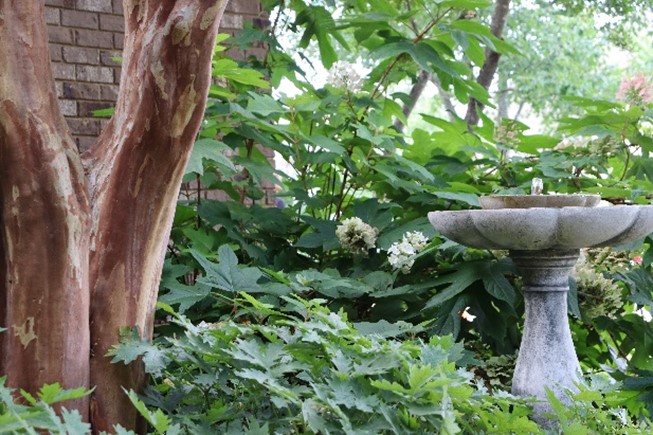
One of the highlights of a garden tour is learning from other gardeners. Each garden you visit has its own vibe that reflects the personality of the person tending it. There is no right or wrong, it is just their style. If your style is similar to theirs, you will think that their garden is beautiful. If their style is different from your own, you will find it less appealing to your sensibilities. Regardless of the style you will always take away some nugget of knowledge from any garden you visit.
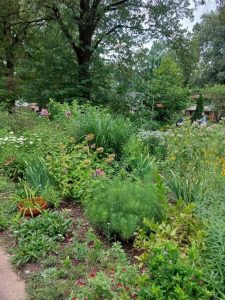 I should have taken my son along with me this year to Experience Memphis Gardens so he could have gotten some tips. He has a slope in his front yard that is difficult to mow. He decided that a naturalistic garden or a meadow garden would be a good solution for his slope. He purchased a wildflower seed mix and strew the seeds on the slope with visions of creating a beautiful wildflower garden. He did not get the beautiful meadow hillside he envisioned. If any of his seeds had germinated, they were overwhelmed by the plants and seeds that had preceded them. His slope was covered with several flowering native plants that most would classify as weeds. It had no sense of design and was quite wild and unkempt looking. He also got a letter from the city to mow the hillside.
His idea was a good one. Growing only native plants or a great percentage of native plants in your landscape is a popular trend for many good reasons. Often these plants are intended to have the look of a meadow with drifts of flowering plants and grasses. These gardens tend to have a less formal appearance with little or no lawn areas. My son’s hillside was downright wild and untamed in appearance and to many it projected the appearance of an abandoned property with tall plants crowding onto the sidewalks and pathways.
Gardens like his will often have signage in the yard that explains the intent of their gardening style. Many of these gardens have been certified by any of a number of non-profit organizations that promote native plantings, pollinators, or wildlife habitat. Some gardeners focus their efforts on a specific group of insects such as pollinators and some certify their garden for a single insect by becoming a Certified Monarch Butterfly Waystation.
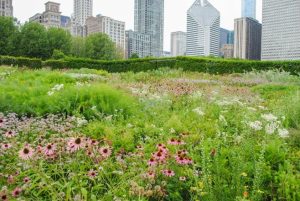
What I learned from attending garden tours this year is that it is possible to feature natives and have a garden that is the envy of the neighborhood. I saw gardens with little or no lawn planted with the same plants as you would find in gardens with a wild abandoned look. Plants like mountain mint, coneflower, milkweed, yarrow, goldenrod, sunflower, cardinal flower, Mexican hat, black-eyed Susan, and Joe Pye Weed to name but a few. The main difference between the wild garden and the one that is envied is not what to plant, but how to plant, as in plant placement and arrangement within the garden.
A native garden takes just as much thought and preparation and maintenance as any other ornamental garden. The idea that you can throw out some seed and let nature manage the garden going forward is ill advised. Success will be achieved only through careful planning on ongoing maintenance. When creating a native garden, it is recommended that your plant pallet be a collection of species that have the same soil, light, and moisture requirements that your site provides. The plants should be compatible with each other. That is, they should be able to coexist, with each having a niche complimentary to the others so they can all survive. Keep in mind your goal landscape when envisioning your native garden. It need not be a prairie garden or wildflower meadow. It can be grasslands, woodland, forest, or forest-edge landscape. Using small starter plants, in a fairly dense planting arrangement you will get off to a strong start. Once established you must maintain the garden for the look you want. A prairie garden not maintained here in Memphis, TN would fairly rapidly progress to a forest.
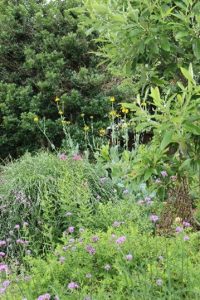 Gardens of course exist to please people and your preferred style whether it be naturalistic, formal, or minimalist modern. Because the style of the garden is often perceived from the hardscape elements and how we frame the edges, consider your preferred style when designing pathways. A formal garden will have hard surfaces of concrete, or a cut flat stone like slate or bluestone with straight pathways. While the cottage garden may use grass, gravel, or flagstone pathways. A prairie garden may use gravel without any defined edges and a winding path. A forest garden may use pine straw or other mulch from locally available materials.
In an established natural plant community, the distribution of plants is seldom equal with a handful of dominant species defining the landscape so limit your plant pallet. To help keep weeds at bay you should consider planting densely in layers with succession in mind. Spring ephemerals appear early then fade and retreat to be replaced by other perennials or self-seeding annuals. A low growing plant or grass can be used as a living mulch covering the ground while allowing taller plants to emerge above them. This filler layer of taller plants has a presence for most of the year with stems or seed heads providing for winter interest. Many of these plants display colorful blooms for several weeks at various times to provide for succession of bloom. Structural plants are the tallest in the garden providing a visual anchor. The concept of layering and succession is important in any garden style from grassland to forest.
The most common native gardens tend to be patterned after prairies or wildflower meadows. When you think of grasslands, meadows, and prairies you envision vast open spaces. There are several famous gardens that recreate this look in an urban setting such as the Lurie Garden in Chicago. However, it is still on a grand scale covering 2.5 acres. Here plants are placed in large sweeping drifts. It can be more challenging to try to recreate this look in a small urban garden setting. Rather than drifts of plants group them in clumps to create impact. Plant shorter plants along sidewalks and paths and save your taller plantings for the center of the garden. Because humans prefer landscapes with long views plants that exceed waist or chest high can appear overwhelming. Choose varieties that will top out at 18-30 inches. You need not abandon your favorites, however. Plant breeders have been working hard to respond to the popularity of natives in urban gardens. For example, while Joe Pye Weed typically reaches 5-7’ there are new varieties that are more suited for an urban garden. Little Joe has a height of 3-4’ and Baby Joe tops out at just 2-3’.
If you are interested in more information, I can suggest an excellent book that goes into depth on designing sustainable gardens, PLANTING IN A POST-WILD WORLD by Thomas Rainer and Claudia West. PRAIRIE UP by Benjamin Vogt is intended to be a how to book to convert your lawn into a natural garden.
