
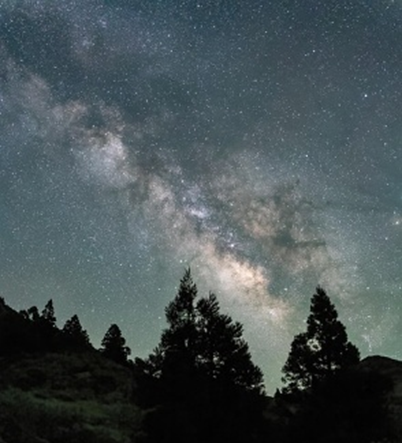
Over the holidays, family gathers, and stories are shared. One story that my kids enjoy is what it was like to be a child when I was growing up. Apparently, it seems these whippersnappers think I am old and are fascinated to hear about the old days before computers and cellphones. A time when there were only three television stations to choose from, all of which shut down programming around midnight. In my youth, photos were black and white, as were the television shows. Then I tell them about how their grandparents grew up without refrigeration and relied on blocks of ice to keep their food from spoiling. So much change in very little time.
Because our time on earth is relatively short and our experience is only with the present, it is difficult to understand how significant the changes have been, even over the period of two generations. But some bellwether events can bring our attention to the changes around us. I grew up in Cleveland, Ohio, and when the Cuyahoga River caught fire in 1969, it woke America up and moved us to take action against pollution, and helped inspire the Clean Water Act and the creation of the EPA.
Other changes are not as dramatic. Being a city boy, I looked up and saw stars at night, but it wasn’t until I camped at the Grand Canyon that I could see what I was missing. It was absolutely amazing. Have you ever observed the Milky Way? It has been 70-100 years since city folk have been able to see the Milky Way due to street lights, signage, and general lighting of our environment. The stars are still there, but we have polluted our skies with excessive light that makes them invisible to us. You can see the glow of cities as you approach them on the highways, but you can’t see the stars. Few of us miss the stars because we have never experienced them in our lifetime. You have to get away from the city to experience their awe. Once you do, perhaps it will be your burning Cuyahoga River, and you will take action to help bring back the stars.
Light pollution is a matter of aesthetics to humans who want to see the night sky’s splendor. For other creatures our the environment, light pollution has more significant effects. Illuminated buildings confuse migrating birds accustomed to navigating by the stars. Some collide into windows, and others drop from exhaustion after hovering moth-like around the lights. With the estimated number of bird deaths over 100 million a year, major skyscrapers in Chicago and New York have begun shutting off their lights.
Researchers found that artificial night lighting disrupts the physiology and behavior of all the nocturnal animals they studied (half the species on earth are nocturnal), including birds, bats, frogs and salamanders, fish, fireflies, and zooplankton. Bats that consume large quantities of mosquitoes are less likely to inhabit lit areas. Sea turtle hatchlings are decimated when they are drawn toward unshielded street lights instead of the safety of the open ocean. Artificial light sources can blind or disorient insects, causing them to circle the lights endlessly. This “fatal attraction” diverts them from critical tasks like finding food, avoiding predators, and reproducing, and many die from exhaustion before dawn.
Reversing light pollution is not complicated, and the effects are immediate. There are a few simple things we can do. First, use light only when and where it is needed. We believe that light will deter criminal activity and increase safety, so we tend to light more than is necessary. If we want to secure an entry point to a home or business with light, we need only to light the entries. It does not require the entire driveway or parking lot to be lit. Better yet would be motion sensors to trigger the lighting. There is no need to light it up if no one is there. Use the lowest light level required, being mindful of surface conditions, as some surfaces may reflect more light into the night sky than intended.
Often, we light up areas that seem sinister, like alleyways and backyards enclosed by fencing. Remember, for safety, the idea of the lighting is to make the intruder visible. If there is no one available to observe or there is no sight line into the area, the lighting would only make things easier for an intruder. Motion detection that turns on lighting also draws attention to an observer, alerting them to the potential threat.
Second, use a warmer colored white light. A 3000K temperature white light produces a softer, warmer, and less intense light than the harsher blue-rich light (4000K or higher) typical of “cool white” lights. It is the blue light that disrupts human and animal circadian rhythms. It also scatters less in the atmosphere, which helps reduce urban skyglow and minimizes light pollution.
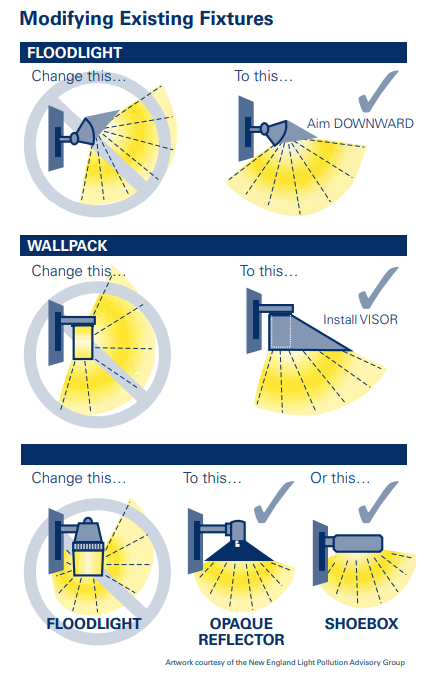
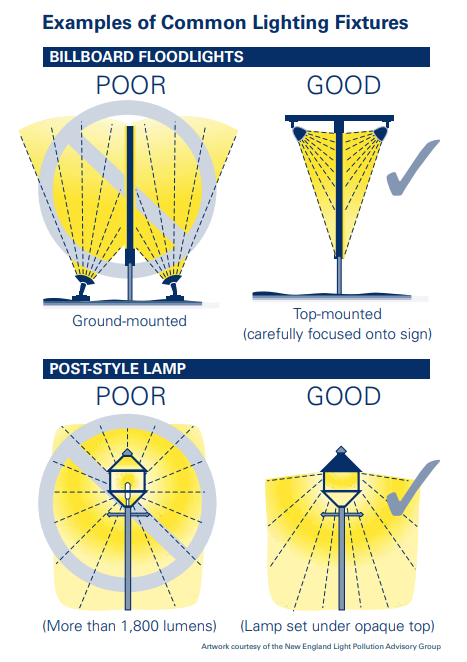
Third, use shielded lighting so that the light shines downward and only lights the targeted area. Modifications to the light fixture itself can prevent light from scattering into the environment and disrupting wildlife.
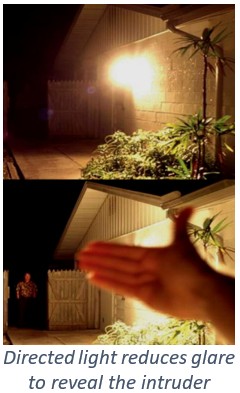
Directed light reduces glare to reveal the intruder
Full cut-off fixtures are designed to direct all light downward, preventing any light from spilling horizontally or upward into the night sky. This reduces the “vacuum cleaner effect” that draws insects from their habitats. Some companies are developing special optics that guide light with high precision. This can provide sufficient illumination on a path or road while making the bulb itself nearly invisible from the perspective of flying insects.
If you have ever been blinded by an oncoming cars high beam headlights you have experienced glare. Shielded lighting reduces glare which can actually improve the security provided by your lighting.
In 2024, the City of Memphis, TN, completed the changeover of its street lighting from the “cobra head” high-pressure sodium lights installed in the late 1950s to new energy-efficient LED fixtures with a “full cut-off” design and warmer colored 3000K white light.
The new fixtures were installed primarily to improve lighting and cut operating costs. However the city rightly went further to assure the lights had the Dark-Sky Association (IDA) seal of approval.
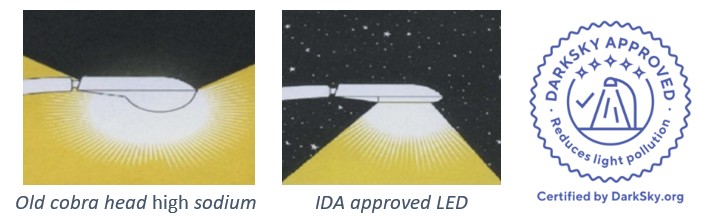
- Old cobra head high sodium
- IDA approved LED
A similar conversion was finished earlier in Tucson, Arizona. After converting they measured an actual skyglow decrease of about 7%. However, the overall visual impact on the night sky was even less pronounced, as other forms of urban light pollution still contribute significantly.
As homeowners we need to do our part. We can upgrade our lighting to dark sky friendly fixtures to reap these same benefits. You can search for dark sky friendly lighting of all types at Dark Sky Internationals’ online database. You can also look for their seal when you are buying lighting at your favorite local store. Additionally we can also petition your local government to update lighting ordinances to ensure all outdoor lighting meet dark sky criteria.
It is not often that we can turn back the hands of time at the speed of light to effect a change for the betterment of humans, the environment, and our pocketbooks!
