
Privacy Screening – Solutions for Gardeners
When we find the need to block a view, it can’t happen fast enough. Sometimes we are looking for a means to block a view that is outside our gardens. When you have worked hard to create a beautiful garden, you probably don’t want to look at the new cell tower that was recently installed on the street behind you. Sometimes we are looking for a means to block a view into our gardens, like when you were finally able to install a new swimming pool and find that you can’t resist the idea of skinny dipping, but don’t want to put on a show for your neighbors. It is times like these that gardeners are looking for a quick solution that will be aesthetically pleasing. The typical solution is to turn to privacy fencing. But fencing has its limits. Often, fences are not high enough to do the job, and the most affordable ones tend to be boring and a little ugly. So now the view we need to screen is the fence itself!
One design trick to hide an offensive view outside our garden is to keep your eye from looking toward out by providing a strong horizontal line, such as a well planted border or by having a focal point that pulls your attention into the garden. Another design solution is to build a berm garden. Bring in enough soil to create a mound along the area you want to screen, then plant into and on top of that mound. The mound itself can be a few feet or even higher if you have the room for it. This solves several problems. It provides some initial height, giving you the equivalent of several years of plant growth; it provides for good drainage, and it allows you to control the makeup of your soil.
If you are trying to screen views into your garden with plants, we tend to want fast growing plant solutions. Patience is one virtue gardeners often lack, and to get an instant privacy hedge will require a big budget to purchase and install large specimens. Smaller fast growing plants are a second option, but plants that grow quickly come with their own issues, such as being thuggish and difficult to control in a garden (Bamboo), or are finicky to care for and prone to disease, such as Thuja standishii × plicata(‘Green Giant’ Arborvitae), here in the Mid-South.
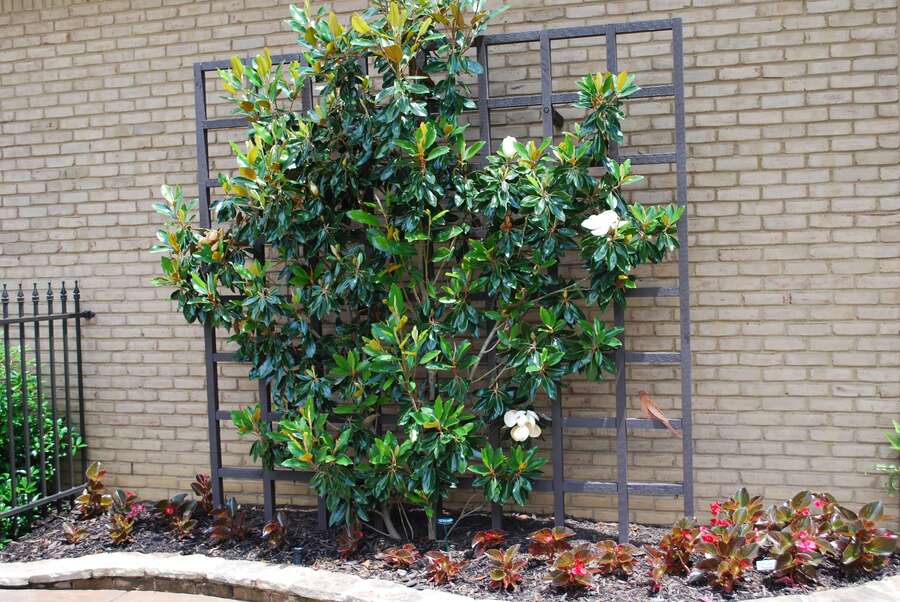
 When considering a plant solution, you need to decide if you need a year round (evergreen) screen or can tolerate a deciduous solution that will leaf out in time for swimming season. If you are looking for an evergreen solution that is fast growing, Ilex ‘Nellie R. Stevens’ holly is a good choice for the Memphis area. If you have room, a smaller variety of southern magnolia, such as ‘Teddy Bear’ or ‘Little Gem’. For tight spaces, Eastern Red Cedar Juniperus virginiana ‘Taylor’ is an excellent choice as it will grow 20-25 feet tall and remain only 3-4 feet wide! If you need a screen under tall trees you will need a shade lover, consider Florida Anise Illicium floridanum at 10-15 feet tall. For the added appeal of fragrance, consider Sweet Tea Olive Osmanthus fragrans, also at 10-15 feet tall. By growing a plant in a flat plane, as an espalier, you can limit the amount of real estate needed for your screen. It is more work but well worth the effort. However if you want to save yourself the effort of pruning be sure to choose plants that will fit the space and will not need constant maintenance to be kept in bounds.
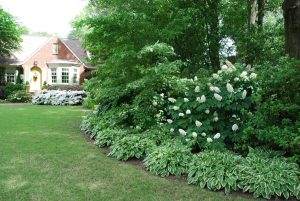 Rather than planting a row of the same plant, consider a mixed planting with three or more different plants to provide a variety of colors and textures. Not only is this more visually interesting the diversity is an insurance policy. We have all seen a hedge with a single dead plant that is about as appealing as a smile with a missing tooth. The freeze of 2020 took out most of the cryptomeria plants in Memphis some complete screen plantings were lost due to this. Should disease or pests arrive it targeting your chosen specimen it will spread quickly and easily along your continuous planting. With a blended planting, you can lose one of your plants but will still have an attractive screen in place.
Vines offer a fast growing solution, but will need to have a structure to support them. Again, a little research is well worth the time, as many vines can be tough to keep in control. There are two types of vines: those with winding tendrils that wrap around a support structure and those that have roots or pads that will cling to a surface. I would avoid the clingers on painted surfaces, as repainting requires removing the vine and cleaning the surface of stuck on plant material before repainting. If you are using a support structure, make sure it is sturdy and large enough to hold your plant material. If it is located close to your home, it is good to leave room behind the structure for air to circulate behind it.
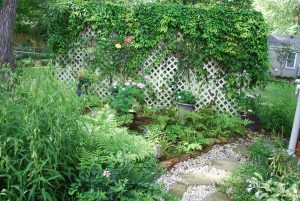 Most vines that perform well in our area are deciduous, but if they are on a structure such as cattle fencing or lattice panels, the vines and their support provide some level of privacy through the winter until the vines leaf out in spring. Avoid Chinese and Japanese wisteria which require high maintenance to control. As an alternative, choose American wisteria (Wisteria frutescens) which is a considerably less aggressive plant. Summer wisteria (Millettia reticulata) is rated for winter hardiness zone 8-10, but I have had good results with it in Memphis. I have had it for about 7 years, and it died to the ground once during that time but came roaring back from the root without missing a beat. It has a prolonged bloom period in summer and holds its leaves until we get a hard frost. While Trumpet vine is highly aggressive, you can get a similar effect with Crossvine, which is easily managed and is semi-evergreen, holding its leaves until we have a hard frost. Bignonia capreolata ‘Tangerine Beauty’ is a show stopping mass of blooms in the spring.
Climbing and rambling roses may not be vines, but they have growth habits similar to vines. Rosa banksiae, or Lady Banks rose, is nearly thornless with a yellow or white bloom and is semi evergreen here in Memphis. Rosa ‘Peggy Martin’ is another popular variety with pink blooms, but it has thorns. Both of these rose varieties put on a big show in spring and will occasionally offer some sporadic blooms later in the season.
The options for an evergreen vine for year round privacy in Memphis are fairly limited. English Ivy (Hedera helix) will require some maintenance to keep it under control. Trachelospermum asiaticum, Asian star Jasmine, may be a lower maintenance option.
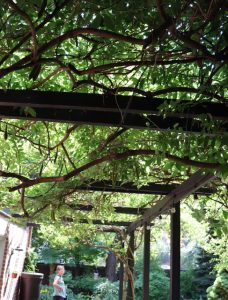 Because Memphis has an 8a hardiness rating, you will see two good vines recommended if you search online. Evergreen clematis (Clematis armandii) and confederate jasmine Trachelospermum jasminoides ‘Madison’ are both touted as evergreen, and both are fragrant. I have experienced issues with both in my garden. Confederate Jasmine dies to the ground almost every year, but it reliably comes back from the root. I have been unable to keep evergreen clematis alive in my garden, although I have seen it thrive for other gardeners in Memphis. I believe the issue for these two vines is the fact that, while these vines can easily handle the low temperatures for zone 8a, we are in a transition zone. Rather than staying cold throughout the winter, it is common for us to have winters when, after cooling down, we get a prolonged warm spell bringing plants out of dormancy, followed by a severe cold snap that the plants aren’t prepared to handle. The “juicy” stems and buds freeze, which destroys the plant tissue. This is also why we have problems getting mophead hydrangeas (Hydrangea macrophylla) to bloom reliably in Memphis.
If you are open to a little construction project, a pergola can be a solution. It provides a sense of enclosure and keeps the eye lower in the garden. It can also support vines or a lattice “roof” to provide privacy when viewed from above, like the neighbor’s second floor window.
Enjoy your newly created private garden, but don’t forget that gardens should be shared, so invite friends over to enjoy it with you, and consider being on a garden tour such as Experience Memphis Gardens!
