
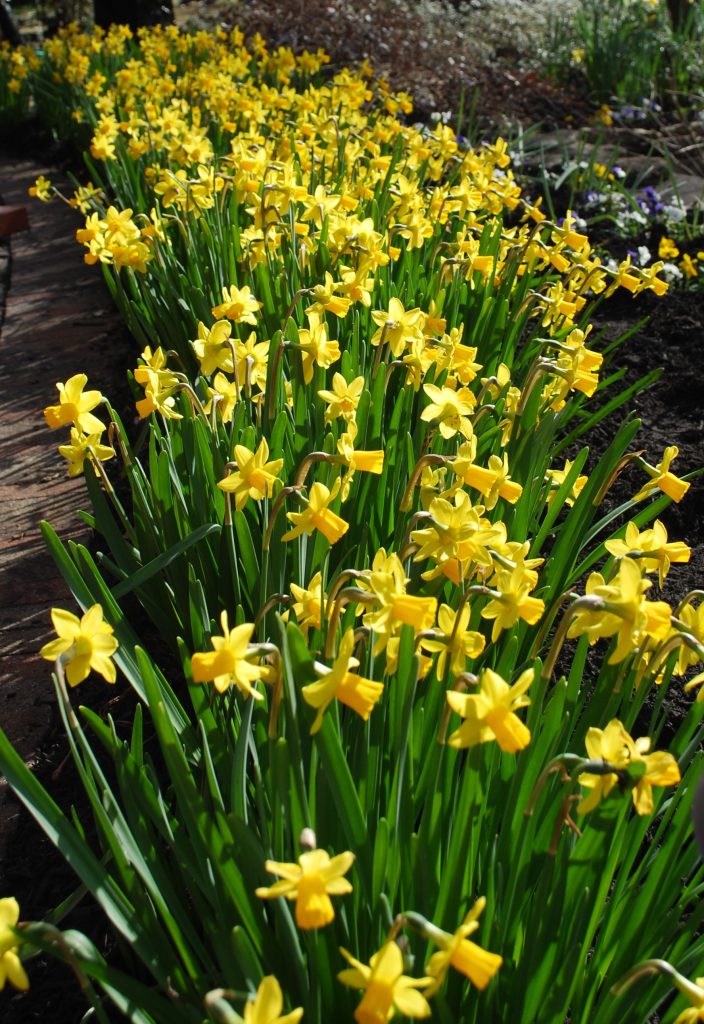
The Miracle of the Daffodil
March 2026 By Tom Rieman
Originally, I thought I might title this article as “The Lowly Daffodil”. My idea was that such a ubiquitous flower that you see growing in so many Mid-South gardens is often taken for granted. It is so easy to care for, just pop it into the earth and forget about it, yet be rewarded with a lifetime of blooms! They are so effortless that you see them growing among the tombstones in ancient graveyards. You see them growing in highway medians. You can also find them in vacant lots marking the flower beds of a house that was long ago bulldozed and hauled away. These miracles of persistence and determination grow despite neglect. A bundle of grit all packaged up in a single small bulb that only asks to be tucked into the ground and left alone.
The daffodil is one of the most beloved harbingers of spring. You cannot look at one without feeling joy and becoming hopeful that it is a sign of winter’s end and the start of the reawakening in the garden that we call spring. Often, you will find their blooms covered by a late snow as a result of their early bloom season. Perhaps this is why they are so loved and were brought to North America by European settlers in the 1600s–1700s.
They do not provide much ecological value but do provide some early season nectar support for generalist pollinators. Overall, they have a neutral to slightly positive impact on the ecology. They cannot replace or undermine native plants. The lack of significant ecological benefit, however, is good news for gardeners who appreciate their beauty because deer, rabbits, and voles leave them alone. Squirrels (the devil’s spawn) will not eat the bulbs or plants, but may dig them up.
 When you begin to talk about daffodils with others, it can cause a bit of confusion because this plant has many common names. Often, their name is regional in its use. Here in the Memphis, TN area, it is referred to as either Daffodil or Jonquil. In the Deep South and Gulf Coast areas, it is generally called Jonquil while Northern, Western, and Midwest states call it a daffodil. However, you will also hear it called a Narcissus, which is a name often used by gardeners and plant enthusiasts. Just to clear things up. Daffodil is the most commonly used name, while Jonquil is a regional name, and Narcissus is the scientific genus name.
Of course, horticulturists love to use the scientific names to avoid such confusion and will point out that all daffodils are narcissus, but not all narcissus are daffodils. Some of the distinctions are that true jonquils, a subgroup of narcissus, have multiple small flowers per stem (often 2–6), a strong, sweet fragrance, and rounded, reed-like leaves (not flat like most daffodils).
About the only thing that is important to daffodil care is a hands off approach to their foliage, which should be left alone until it yellows. This is important for the plant to store energy and rebuild its bulb for the next year. Some gardeners with obsessive compulsive disorder, or too much time on their hands, will braid the foliage to neaten it up as they wait for it to yellow. While this looks nice, it restricts the amount of light reaching the leaves and shortchanges the bulb of the energy it needs to store. If you want something to do once the daffodils have flowered, you can deadhead the bloom to redirect energy going to seed production back into building the bulb.
If your daffodils are not blooming, it may be because the foliage was cut back before it had a chance to recharge the bulb. Bulbs planted in too much shade likewise will not get enough light to refuel the bulb for the following year. Aim for half a day of sun exposure. Over fertilization can also cause flowering issues. Make sure that your bulbs are not being fed with a high-nitrogen fertilizer. Too much nitrogen will encourage foliage growth at the expense of blooms. Occasionally, bulbs are over fertilized due to getting nitrogen runoff from an uphill lawn or off-target fertilizer application from a lawn feeding program. Also be aware that bulbs do not do well where the water puddles due to disease and bulb rot. They love water during the growing season but must have good drainage.
Daffodil bulbs growing in the same spot for many years may stop blooming and need dividing. New daffodil bulbs are formed every year or two from the original bulb, from two to four to eight and so forth, gifting you additional bulbs. This results in tight clumps that are competing for food and space. And the lack of resources for all the bulbs keeps them from flowering. You can divide these clumps once the foliage has yellowed. Separate them into individual bulbs and replant immediately, about 6″ apart and about 6″ deep. Alternatively, you can delay replanting until fall by drying the bulbs in the shade and storing them in mesh bags. In the Fall you can gift them to friends or replant them. Daffodil bulbs stressed from transplanting may skip a year of blooming if dug and replanted in a different environment so don’t be disappointed with the first year display.
Daffodil blooms come in sizes from 5-inch blooms on 2-foot stems to half-inch flowers on 2-inch stems. Colors range from the most common yellow, white, and cream, but also in shades of pink, orange, and red, often featuring bi-color combinations like white petals with a yellow or orange cup. There are daffodil fanatics who have created The American Daffodil Society, which has local chapters across the U.S. These daffodil aficionados hold daffodil shows and give awards for the best blooms. We are fortunate to have a chapter here in Memphis, TN. And they are holding their 14th annual show on March 15, 2026 1:00 pm – 4:00 pm, to be held at The Dixon Gallery and Gardens. The Mid-South Daffodil Society invites you to our local daffodil show to see the many different varieties of daffodils that can be successfully grown in our area. See the many colors, shapes, and forms available. You can even enter your own daffodil or daffodil picture for judging! (Visit the Dixon website for details) Volunteers will be available to answer questions and provide educational information.
Whether you grow them or not, you can’t help but love the miraculous, lowly daffodil.
