
The Mulch Matchmaker: Find Your Garden’s Perfect Cover
There are many kinds of mulch available to the home gardener, and they provide multiple benefits, including weed suppression, moisture retention, and organic mulch also acts as an insulating layer, reduces runoff, and increases soil fertility. A question often asked is, “Which is the best mulch to use?” You would think it would be a simple answer; clearly, one must be better than all the rest. But like many things in life, it’s complicated. There is, of course, a best mulch for you, but it depends on what you want to achieve by mulching.
Weed Suppression: All mulches help to suppress weeds primarily by blocking light. Our soil is loaded with weed seeds, as many as 450 in a pound of soil. Those in the top two inches of soil are most likely to germinate. A thin layer of mulch may not prevent light penetration to the soil surface, so a thicker layer of 2-4 inches is recommended for organic mulches. Course textured mulch, like shredded hardwood, should be applied to a depth on the upper end of the range, and fine textured mulches such as grass clippings and compost on the lower side of the range. A light reapplication annually will maintain the effectiveness of your mulch, or you may consider applying it more heavily on alternate years.
Moisture retention: Mulch helps retain soil moisture, meaning you will not need to water as much. Simply by shielding the soil from direct sun and wind, research studies found 20–50% less evaporation in mulched vs bare soils.
Insulation: A thick layer of mulch will moderate soil temperature fluctuations and keep your soil warmer in winter and cooler in summer. Memphis has winters that try to trick our plants due to alternating periods of cold and mild temperatures. If our plants warm up and begin to come out of dormancy, their sap rises, and buds begin to swell. When the cold returns, it may cause damage to the plants, killing the flower buds. This is the main reason that we have few or no blooms on our macrophylla hydrangeas in some years. Mulch helps minimize the plant’s response to the effects of these temperature fluctuations and helps them to remain dormant in the winter.
Run Off: Loose, fibrous mulches break the impact of raindrops or spray irrigation, preventing crusting and compaction of soils. This means more water soaks in rather than running off. Over time, as mulch decomposes, it improves soil structure, increasing porosity and water-holding capacity.
Soil Fertility: Over time, as mulch decomposes, it adds organic matter to the soil. Organic matter can hold up to 20 times its weight in water like a sponge, greatly improving the soil’s ability to retain water. As the organic matter is broken down by soil organisms, nutrients are made available to plants in a form that they can use.
In choosing your best mulch match, you will need to decide whether to use an organic mulch like wood chips, compost, shredded leaves, etc., or inorganic mulch such as plastic or decorative stone. Plastic is often used in commercial strawberry production, as well as other vining crops. Seeing the professionals use it, many home gardeners think it may give superior results. Plastic provides a great barrier for weeds and helps to prevent the fruit from rotting. Plastic mulch, however, is considered to be temporary, and both the plastic and the strawberry plant are removed and disposed of at the end of the season. Commercial growers hill up the soil into raised beds for good drainage. Because moisture does not penetrate plastic sheets, a drip irrigation system is often put in place before the plastic is laid. No plastic is laid between rows to allow for water penetration and gas exchange. To plant the crop, a cut is made in the plastic or a torch is used to burn a hole in the plastic. This is a good system for commercial operations as it eliminates the need to weed the planted beds and results in higher yields of a good-quality berry. Black plastic is typically used, but other colors are available as well. The decision tends to be about the impact on soil temperature. Black absorbs the light and is the most effective in warming the soil, so planting can begin sooner. However, black can be a problem later in the season, making the soil too warm. This is why you may see white plastic or even red plastic in fields. Clear plastic lets light penetrate, so it is not typically used.
For the backyard gardener, there are downsides to this approach. First is the cost of replacing plants and plastic annually; the plastic waste must be disposed of, and plastic mulch does not contribute to soil fertility. The alternative use of an organic mulch provides the same benefits plus increased soil fertility. Any need to weed in the home garden is easily managed in a mulched bed.
Woven plastic landscape fabrics allow for moisture penetration and some level of gas exchange. But these, too, should also be considered temporary. They are primarily used by a home gardener for weed prevention. As most gardeners do not like the look of the landscape fabric, it is usually covered with an organic mulch for aesthetic reasons. The fabric is effective as a weed barrier for most weeds originating below the fabric, but a few grasses can come through. However, as new weed seeds land above the fabric, they may germinate, and the roots will grow through the fabric, making it difficult to remove these weeds. Planting annuals or perennials in the bed previously covered with landscape fabric is difficult and requires cutting a hole in the fabric. These types of barriers are best when used underneath gravel pathways or a permanent decorative stone mulch to keep the stone from sinking into the soil and disappearing.
Most decorative stone mulches will help warm soils quickly in the spring and keep them warm in the fall, but they can keep soils too warm in the summer. They suppress weeds for several years, but organic material and soil will build up on top of them over time, leading to weed issues. They can be difficult to garden in, making planting, transplanting, and weeding challenging.
Living Mulches are effectively a ground cover plant that grows under and between your larger perennial plants. While they do compete for moisture and nutrients with other plants in your garden, they are effective at keeping weeds suppressed. An evergreen groundcover means that you no longer need to mulch that garden bed, providing the added benefit of lowering maintenance and providing year-round beauty.
A cover crop is also considered to be a living mulch. It is planted in vegetable gardens after the production season has come to an end. Choose a plant that will grow in our mild Memphis winters. Barley performs well in our area as a winter annual. It is shade and heat-tolerant, and in the spring, it is easily killed, before its seeds mature, simply by mowing it. Additionally, its roots loosen the soil and contribute to fertility. You can just let it lie on the soil surface once cut, or add the cuttings to your compost heap.
Organic Mulches: For most of us, the best choice of mulch is an organic mulch for all the benefits it provides, and because it is aesthetically pleasing. The next choice is bulk or bagged. Most bagged mulch comes in a 2 cubic feet package. To cover a 100 square foot area (10’ x 10’) three inches deep requires 1 cubic yard of mulch (13.5 bags). If you have a large area to cover, bulk may be a better option due to cost. In Memphis, the stone and mulch yards primarily offer shredded hardwood mulch. Single-hammered is coarser than the double-hammered. They also offer dyed mulches. There are no advantages to dyed mulch other than aesthetics. The black dye comes from a carbon source, and the red from an iron oxide source. The ingredients in these two forms of dye are not considered to be toxic to plants. The coloring, however, may fade over time.
Before you mulch, always remove any existing weeds or grass. This can be challenging when establishing a new bed. You can accomplish this by mechanical means (hoeing, hand pulling, etc) or by the use of a chemical herbicide to kill the vegetation. Lazy gardeners like myself follow a different route by first knocking down the vegetation by mowing on the lowest setting of your mower. It is fine to leave the clippings where they are. Then cover the area with two or three layers of newspaper or a single layer of cardboard, making sure that there are no gaps in the coverage. If discarded shipping boxes are used, be sure to remove any tape that will not decompose. Wet down the paper to hold it in place and cover it with your favorite organic mulch. Choose from the following that are readily available in the Memphis area.
- Shredded hardwood mulch is the predominant mulch available in Memphis and is an excellent choice. In heavy rains, it tends not to wash away, and it decomposes slowly for a longer period of protection. Shelby County often offers free single-hammered hardwood mulch available for non-commercial residents at Shelby Farms. It is piled on the south side of Walnut Grove just west of Farm Road. You will need to load it yourself.
- Pine needles are becoming more commonly available for purchase in Memphis. They are attractive, long-lasting, don’t wash in heavy rains, and are easy to work with because of their light weight. An added advantage is that they are “clean”. By this, I mean that you can walk across a bed of pine needles and not track them into your home. If you were to sit on them, you would not soil your clothing.
- Arborist chips – These are the ground-up tree limbs that are generated when an arborist trims or removes a tree. If the work is done when the leaves are on the tree, the leaves are included. They are similar to shredded hardwood but are fresh. You can get them for free from Chip Drop (getchipdrop.com). They are not as pretty as shredded hardwood, but they are free and come with free delivery! But be prepared, you cannot contact them and ask for a yard of chips to be delivered on a specific date. What you will get is a surprise truckload of chips dumped when they happen to have a job nearby. It typically is more than you can use, so get your neighbors lined up to take some from your pile. You will also find some sticks and probably some small branches mixed as well. But free mulch with free delivery is a pretty good deal!
- Grass clipping can be used, but with much caution. If they came from a lawn that has been treated with herbicides, those herbicides may still be active and can damage your plants, doing more harm than good. They should be dried for a day or two before using them in your beds. They do tend to mat, and when that happens, they tend to repel water.
- Leaves – You may have heard the adage “leave the leaves” as a means to help insects overwinter and keep the natural food web in place. If you take your cues from nature and the forest as an example, this is a wonderful mulch. Whole leaves will tend to mat, and if you have plants that you want to reseed in the garden, whole leaf mulch will keep many of these from germinating. While shredding the leaves is not recommended by the insect lovers, it will make a better mulch by breaking down and returning nutrients to the soil faster with minimal matting, allowing for better water penetration. Shredding is easily done by running over them with your lawn mower a few times. If that is too much effort, go to your mulch and stone yard to purchase “leaf mold,” which is shredded leaves that have been further broken down and decomposed.
- Compost can also be used as a mulch. Compost comes from multiple sources, such as kitchen scraps, fresh yard waste, as well as dead leaves, twigs, and small branches. Its special advantage is that it acts as a slow-release fertilizer for your garden. Your compost, however, can be a source of weed seeds if it was not “hot composted”, where the compost reaches 131–160°F for several days to weeks. If you cold compost, that is simply pile up your kitchen and yard waste and letting nature take its course, many seeds can remain viable. Only add plant material that does not have mature seeds to avoid this potential problem.
- Straw works as a mulch that decomposes fairly readily. It is often used in strawberry and vegetable beds.
- Hay, which can provide all the benefits of a desirable mulch, is not recommended due to the amount of undesirable seeds it contains.
- Aged cow and horse manures also contain viable weed seeds. Make sure these are hot composted before adding them to your garden.
When to apply: – Early spring is an ideal time to mulch or renew the mulch in your beds. This means late January through February in Memphis, TN. However, new plantings should be mulched immediately after planting, regardless of when you are planting. If you want to create a new bed for planting in the spring, then fall is a great time to prepare the bed and cover it with mulch so it will be ready to plant in the spring.
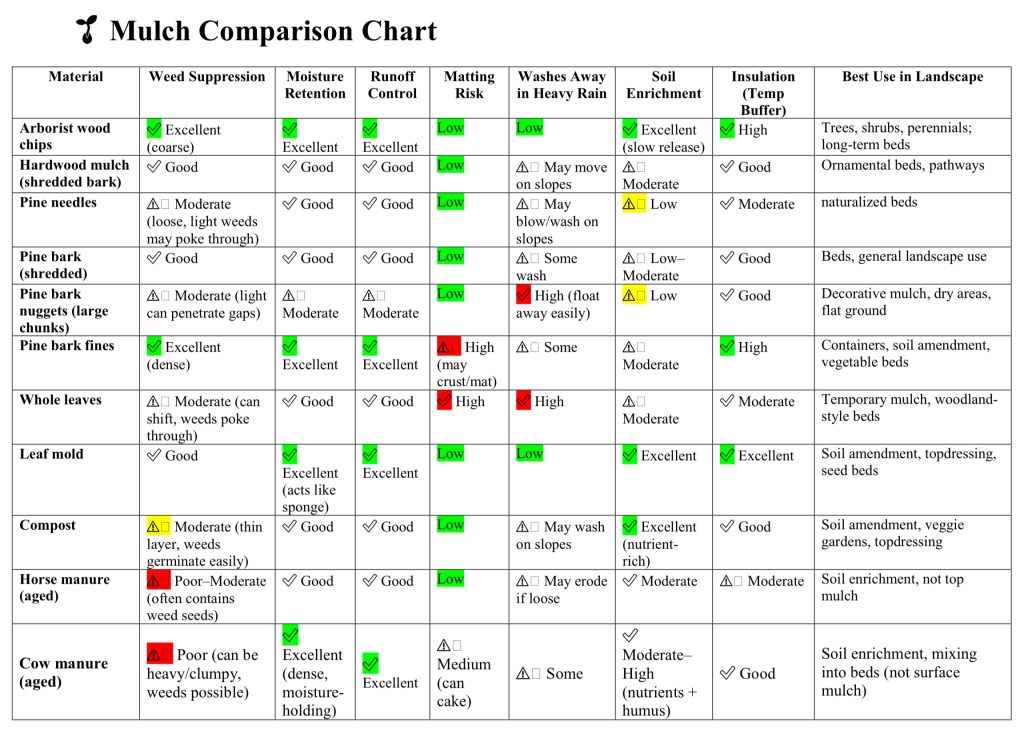
The best mulch is the one you use. Below is a handy chart to help you to make your best match.
🌱-Mulch-Comparison-Chart
Lawn Care: Apply the last fertilization to Bermuda and Zoysia lawns close to Labor Day. Apply preemergent if not reseeding. Sow fescue seeds.
Prune: Do not prune any shrubs or trees except to remove deadwood.
Other:
- Continue to water on weeks with less than 1 inch of rain.
- Continue to monitor for insect and fungal diseases and treat as needed.
- Harvest and dry herbs for winter use.
- Divide and repot any tropical plants you have outdoors to prepare them for their winter home. Hose off or wash plants with soapy water and inspect them for insects.
- If needed, treat them with an appropriate insecticide.
- Purchase (but do not yet plant) spring-blooming bulbs. Order or purchase bulbs now, when the best selections are available. Store them in a cool, dry location until you plant them.
- Apply a pre-emergent weed control to garden beds to prevent winter weeds, and you are not sowing seed.
- Don’t worry about fall webworm. The leaves will be dropping soon, so they are not doing any significant harm to your trees. If you can reach the web with a pole, you can open it up to let the birds get to the caterpillars for a feast.
